Well, sports fans, our pals at RapidShare are again behaving in mysterious ways. Their server has been off-line repeatedly in the last few days, resulting in error messages whenever users try to access files. Which means, of course, that many of the downloads offered here are out of commission for the time being. We at Gems hope this is only a temporary state of affairs, but with these semi-legal file-sharing sites one never knows. I suppose those who avail themselves of free services (as we do at Gems) have no real cause to complain, but RS also has many paying customers who have been stiffed as well. We'll let you know when RS is again up and running, but in the meantime you check for yourself at this site: http://www.isitdownrightnow.com/rapidshare.com.html
Update: RS seems to be back up and running. Get those downloads while you can!
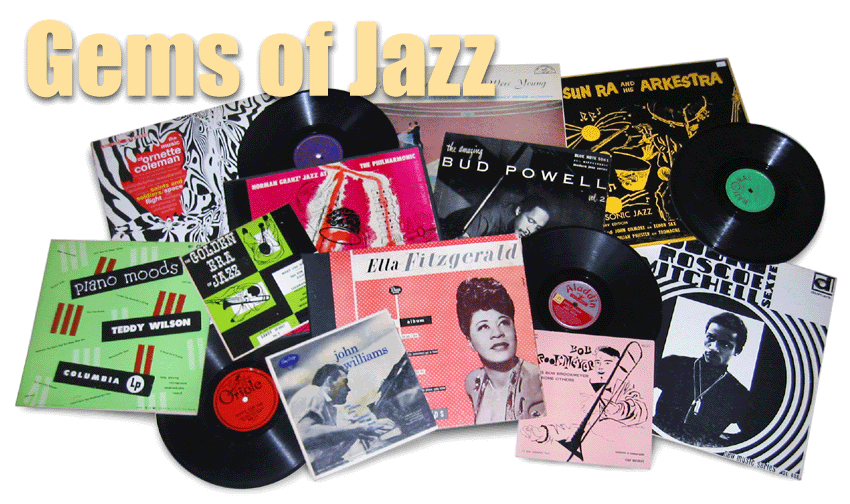
Over the last century, thousands of jazz recordings have assumed their rightful place as classics of the American musical canon. But just as many extraordinary sessions have fallen by the wayside. Gems of Jazz is dedicated to bringing some of those forgotten recordings to light, offering digital versions taken from the shellac and vinyl originals.
Thursday, January 16, 2014

Thursday, January 2, 2014
Shining Light on the Dark Angel
 |
| Eddie South was perhaps best known as a master violinist in Europe where he spent most of his musical career. But he was a Chicago native, and in later years he returned to the Windy City where he was a frequent guest on Dave Garroway's TV show. Photo by William Gottlieb |
Here's another posting that comes by way of a request. A while back, Gene, a dedicated Eddie South fan, asked that Gems put up Eddie's 1959 Mercury recording, "The Distinguished Violin of Eddie South." Now that the holidays are behind us, we have the time to honor that request.
Lovers of jazz fiddle certainly know Stephane Grappelli, Stuff Smith and Joe Venuti. Most know that Ray Nance played a mean violin in addition blowing fine trumpet. But many jazz listeners may never have heard of Eddie South. Why? Probably because Eddie's career extends back to the early days of the swing movement and because he did most of his playing and recording in Europe. His career as a classical concert violinist was nixed early on in this country by his race and, like many of his contemporaries, he found more accepting audiences abroad. There, he was a major star.
 |
| A 1937 promo card for a concert with the Hot Club of France, Django Reinhardt's group. |
South was particularly taken with the folk music of Hungary and the Roma culture (gypsies, in non-PC parlance), and he frequently performed with Grappelli and guitarist Django Reinhardt. A tune he picked up on a trip to Budapest in the late '20s became his theme song, and he played it right up until his death in 1962.
In the late 1950s, the Mercury/EmArcy record label began making recordings in Chicago under the "Wacker Series" imprint (after Wacker Drive in the Loop, the location of Mercury's studios). They did several with Eddie South, and two of those are offered here. The second comes courtesy of Gene, the gent whose request inspired this posting.
"The Distinguished Violin" features Eddie in 1958 working with an all-Chicago rhythm section that includes pianist Eddie Higgins, guitarist John Gray and bassist/producer Johnny Pate. These gents are modernists, several generations removed from South's days as a member of Freddie Keppard's South Side group, but they perfectly complement the violinist's Fritz Kreisler-esque pyrotechnics.
 |
| Eddie's back in town! A clipping from Down Beat from 1948, around the time South was working as a soloist with Earl Hines' orchestra. |
As always, the files dubbed by Gems come from the original vinyl. Those provided by Gene also sound like they were taken from the original LP. Many thanks for the suggestion and for "Birds," Gene!


The Distinguished Violin of Eddie South
Eddie South
Mercury MG 20401
Eddie South, vi; Eddie Higgins, James Todd*, p; John Gray, g; Johnny Pate, b; Al Duncan, d.
Chicago, IL; July 14 or July 15*, 1958
1. C-Jam Blues
2. Around the World in 80 Days
3. Currant Jelly (Johnny Pate)
4. I Hadn't Anyone Till You
5. 1166 (Johnny Pate)
6. Czardas
7. Liebesfreud
8. Nobody Knows the Trouble I've Seen
9. Assurance (Johnny Pate)
10. Fiddle Ditty (Eddie South)
11. Hejre Kati
Find it here: https://www.mediafire.com/?1wiwygltiw606bl


Music for the Birds
Eddie South and Mike Simpson
Mercury Wing MGW 12225
Eddie South, vi; Mike Simpson, fl; others unknown (probably similar to above)
Chicago, IL; 1959(?)
1. When the Red Red Robin Comes Bob Bob Bobbin' Along
2. Skylark
3. The Hot Canary
4. A Nightingale Sang in Berkeley Square
5. Blues for the Birds (South/Simpson)
6. Flamingo
7. Listen to the Mockingbird
8. Let's All Sing Like the Birdies Do
9. Robins and Roses
10. Bird Bath
Tuesday, December 24, 2013
Betty Bebop's Best
 |
| Betty Carter in the mid-'80s, going full bore at the Great American Music Hall in San Francisco: Movin' on indeed! Tom Copi photo |
Every recording that has been posted here at Gems has artistic merit – at least, I believe they do. Some are unjustly obscure, others offer examples of extraordinary musicianship, some are simply fascinating curiosities. This album, though, is different from those. It not only has merit. I think I can say without qualification that it is, from start to finish, an absolute masterpiece.
"Inside Betty Carter" ranks right up there with "Kind of Blue," "Blue Train," "Blues and the Abstract Truth" and any other contemporary jazz classic you might think of. Why "Inside" has never received its due – and why it remains generally out of print – is one of jazz's great mysteries. In an effort to rectify this egregious oversight, Gems offers this download for your delectation and enjoyment.
 |
| James Moody and Betty Carter at the Chicago Jazz Festival in 1982. Marc Pokempner photo |
"Inside Betty Carter" was her last album before going out on her own, and it's a first sign of great things to come.
At a total length of 27 minutes, the record's entire program is shorter than some of the tunes Ms. Carter would sing on stage. But each of these performances is a flawless wonder, filled with nuance, brilliant improvisation and delightful surprises. The backing trio of Harold Mabern – not normally thought of as an accompanist – Bob Cranshaw and Roy McCurdy swing hard and push Betty as much as she pushes them.
The standards here are deconstructed and revitalized as living things – you can suddenly hear the lyrics and the emotion behind them. A Carter original, "Open the Door," one of her signature tunes, is debuted on "Inside," and the singer's reworking of "My Favorite Things" is a 90-second encounter with genius.
Betty Carter never had the instrument that Ella or Sarah had. Her voice was high and her sound was sometimes breathy and thin, but her range and musician's ear led her to develop a style that was stunningly adventurous and purely expressive. That style gets its start with this recording. If you've never heard it before, get thee to Rapidshare!
As always, these files come from the original vinyl, no cleaning of the sound required. A word of warning: these are wav files and are much bigger than our usual mp3s. The download time may be rather long ...


Inside Betty Carter
Betty Carter
United Artists UAS 5639
Betty Carter, v; Harold Mabern, p; Bob Cranshaw, b; Roy McCurdy, d.
New York, NY; April 1964
1. This Is Always
2. Look No Further
3. Beware My Heart
4. Something Big
5. My Favorite Things
6. Some Other Time
7. Open the Door (Betty Carter)
8. Spring Can Really Hang You Up the Most
Find it here: https://www.mediafire.com/?4xckaf3obteoz5g
Sunday, December 22, 2013
Greetings of the Season

Happy holidays to one and all of Gems' visitors. Here's a souvenir from the heyday of swing, given to me by a jazz friend a few decades back. I don't know where he got it, but he knew lots of musicians so I suspect it may have come from one of them. I know most of the 28 signatories (I think there's 28), but I don't know all of them. Who's Sonny Kendis? Or Basil F-something? If you know, fill me in. In the meantime, best wishes for the season, and prosperous New Year to all of you from all of us here at Gems!
Sunday, December 8, 2013
Land of Folk
 |
| Mr. Land in action at an Emarcy session in Los Angeles with Clifford Brown and Max Roach. Photo by William Claxton |
When I think of the great tenors of the 1950s, Rollins, Dexter Gordon and Coltrane immediately come to mind. Somehow, I always overlook Harold Land. His participation in the Max Roach/Clifford Brown quintet should at least earn him an honorable mention in any list of reed notables from that period. And his work with long-time partner, Bobby Hutcherson, extended his legacy well into the '70s and '80s. If you want proof, you only have to sample this offering.
Land came from Texas, but he made California his home. Even though he'd recorded as a leader in 1949 (for Savoy) and had his own group, he joined Max Roach's band in 1954. That led to national exposure, and though he was overshadowed by trumpet star Clifford Brown, he was generally regarded as an excellent hard bop soloist. He eventually left Roach before Brown's death in 1956 and gigged around Los Angeles, making numerous recordings for the Pacific Jazz, Jazzland and Contemporary labels. His work with Curtis Counce and with his own groups from the early '60s is some of his best.
Which leads us to the present download. Imperial was making jazz records on the West Coast at the time, notably with Sonny Criss, but they also got Harold Land into the studio for a few sessions. In 1963, college students were going gaga over the sounds of folk music (the Dave Brubeck craze had faded), and the A&R guys at Imperial hit upon a brilliant scheme to revive jazz's popularity on campus. They would assemble an excellent hard bop quintet and have the boys play ... folk songs. Yes, that's the hook.
It sounds like a recipe for some pretty lame music, right? Bad folk, worse jazz. Well, not so in this case. Don't let the selections put you off. "Jazz Impressions of Folk Music" is a superb album. The arrangements, which are uncredited, take these hoary melodies, deconstruct them and reassemble them into intelligent and hip vehicles for jazz blowing.
 |
| The brilliant trumpeter Carmell Jones, ax in hand. |
Harold himself demonstrates his complete mastery of the horn, evoking Sonny Rollins at times, and running the changes with the fluidity of Sonny Stitt. John Houston, on piano, is the least well known of these players, but he'd worked numerous sessions with, among others, John Coltrane. Jimmy Bond is a familiar figure from his many Pacific Jazz recording dates, and Mel "Lee" is perhaps better known as Mel Lewis. I don't need to tell you about him.
So here are eight folk chestnuts, transformed into jazz classics. I think I found this obscure album in a used record store many years ago, but it's in pristine shape so no cleaning of the sound was required. As always, the tunes are ripped right from the original vinyl.


Jazz Impressions of Folk Music
Harold Land Quintet
Imperial LP-12247
Harold Land, ts; Carmell Jones, tp; John Houston, p; Jimmy Bond, b; Mel Lewis, d.
Los Angeles, CA; 1963
1. Tom Dooley
2. Scarlet Ribbons
3. Foggy Foggy Dew
4. Kisses Sweeter Than Wine
5. On Top of Old Smokey
6. Take This Hammer
7. Blue Tail Fly
8. Hava Nagila
Find it here: https://www.mediafire.com/?7chc11tpow4c5pp
Saturday, November 16, 2013
The Thin Man
 | |
| Just a bunch of masters playing Just Jazz: Wardell Gray at the Gene Norman concert, offered below, on April 29, 1947. With him are, from left, Irving Ashby, Charlie Drayton, Benny Carter and Howard McGhee. Photo from "Black Beauty, White Heat" |
Here's another sampling of from one those "other JATP concerts." It comes from two Gene Norman "Just Jazz" shows at the Pasadena Civic Auditorium and the Shrine Auditorium, one from April and the other from December of 1947. These selections – three of them, actually – feature the immortal Wardell Gray, one of my favorite tenor players and I assume one of yours, too.
Wardell's on stage with the gents above plus Vic Dickenson, Benny Carter, Jackie Mills and Vido Musso for several of these tunes, but the showstopper is a feature for the tenorist with Erroll Garner at the keyboard on "Blue Lou." Gray's superb tone and cool control are on display throughout the six minute performance and his ease with melody and improvisation evoke Lester Young in modernist guise. According to a very informative Wardell Gray website, Benny Goodman heard "Blue Lou" and was impressed enough to hire Gray for his band, saying, "If he's bop, that's great. He's wonderful!"
 |
| Benny and sideman Wardell in 1948 or '49. |
It's unfortunate that Wardell died in Las Vegas in 1955 just as the technology was shifting away from the 3-minute, 78-rpm format to long-playing microgroove records. One would have liked to hear him stretch out in the studio as he does on these concert recordings. As it was, he died mysteriously, either by accident or at the hands of gangsters, several months after his former employer, Charlie Parker, expired in Baroness Nica's New York apartment. Both Bird and Wardell were 34 at the time.
So here is some first-rate Wardell Gray, accompanied by several other giants of the music. The great Benny Carter is on alto, as fluid and suave as ever, and Howard McGhee crackles on trumpet, hitting all the highs and bursting with ideas. There's the Elf, too, Errol Garner, comping along and soloing in his distinctive style. "Tenderly" is all his, one of the very few times he ever recorded that tune, believe it or not. His performance sounds to my ears like a studio recording as no crowd is audible and it's a solo spot, but the authorities say it came from the Civic concert stage so I won't quibble. This record, by the way, is another from that cache that was found in an attic by my friend who cleans out houses for a living. That's why it's got the number "58" on it – all those sides were numbered for some reason by their original owner.
The download comes from the original vinyl, as always, and required no cleaning of the sound at all.


Way Out Wardell
Wardell Gray
Crown CLP 5004
Wardell Gray, ts; Errol Garner, p; Irving Ashby, g; George “Red” Callender, b; Jackie Mills, d.
Just Jazz Concert, Civic Auditorium, Pasadena, CA; April 29, 1947
1. Blue Lou
Howard McGhee, tp; Wardell Gray, Vido Musso, tp; Arnold Ross, p; Barney Kessel, g; Harry Babasin, b; Don Lamond, d.
Just Jazz Concert, Shrine Auditorium, Los Angeles, CA; December 27, 1947
2. Just You, Just Me
Howard McGhee, tp; Vic Dickenson, tbn; Benny Carter, as; Wardell Gray, ts; Errol Garner, p; Irving Ashby, g; George “Red” Callender or Charles Drayton, b; Jackie Mills, d.
Just Jazz Concert, Civic Auditorium, Pasadena, CA; April 29, 1947
3. One O'Clock Jump
Errol Garner, p.
Just Jazz Concert, Civic Auditorium, Pasadena, CA; April 29, 1947
4. Tenderly
Find it here: https://www.mediafire.com/?ykwwook9nwtp0kg
Friday, November 8, 2013
Lambert, Avakian and Pennebaker
 |
| A life in harmony: Singer Dave Lambert enjoys a moment in the New York sunshine, about a year after making his debut recordings with fellow vocalist Buddy Stewart and trumpeter Red Rodney. William P. Gottlieb photo, from Wikipedia |
I belong to a jazz service hosted by the tireless Jim Eigo, and it supplies me with no end of interesting stuff about the music we love. Most recently, Jim sent me a link to a marvelous little film that you may already know about but was news to me. The movie is a fifteen-minute bit of cinema verite called "Audition at RCA," made by a young film maker named D.A. Pennebaker.
We Baby Boomers know Pennebaker as the guy who followed Bob Dylan around England with a Bolex in 1965 and who made the landmark documentary "Monterey Pop" in 1967, but who knew he was a jazz fan? I certainly didn't. Anyway, "Audition" is an intriguing glimpse into 1960s jazz making, with record execs, A&R guys, engineers in suits and obscure jazz musicians who punctuate their sentences with "crazy!" The performers – aside from Messrs. Lambert and Duvivier – are all largely unknown, but they acquit themselves admirably, and watching their interplay as they negotiate the complex lyrics and harmonies is fascinating. The striking Ms. Vonnie is especially charming and Dave himself comes off as a benevolent goateed elf in a stingy-brim fedora. And there's Columbia legend George Avakian, too, one of Black Rock's great champions of jazz.
The film is reposted here from a jazz blog called JazzWax, the creation of Marc Myers. He supplies this commentary on the film, explaining the action and who the players are:
Audition at RCA
By Marc Myers
 |
| Steve Sholes and George Avakian |
To recap the names of those in the film, that's George walking up just as Lambert and his singers – David Lucas, Leslie Dorsey, Sarah Boatner and Mary Vonnie – emerge from Dave's car. In the recording studio, they were backed by Moe Wechsler on piano, George Duvivier on bass and Gary Chester on drums.
 |
| Ernie Oelrich |
A few months ago, as I was writing the liner notes for "Miles Davis: The Original Mono Recordings" – a box set due on Nov. 11 – I spent time with George chatting about the Davis sessions. I also brought my computer to show him "Audition at RCA," which he hadn't seen in decades. We talked about the audition, and George gave me the names of most of the remaining people in the film:
"At the beginning, it appears as if I had asked Dave to meet me outside and that I was championing the session. In truth, I had found out about the session only an hour or so before and agreed to tag along in case I could be of help.
 |
| Sholes, Avakian and Ben Rosner |
"The guy to my right is Steve Sholes, the director of RCA's pop department. The guy I'm talking to without a jacket is Ben Rosner, an RCA promotion man. He's probably the one who got Dave the audition, and Steve probably set up the session.
"The musicians were terrific. George Duvivier was an absolute rock in the studio – he knew exactly what to do the first time, perfectly. The same was true about Moe and Gary.
"I'm not sure why the audition didn't result in an album. I think the reason was that Dave didn’t have enough new original material for a full 12-inch LP. At any rate, the decision to do the album would have been Steve's. I was in charge of the overall department but Steve was in charge of pop. I wouldn't have overruled him or stood in the way of what he thought was best."
Tragically, Dave Lambert would be killed a few years after this session, in October of 1966. He had stopped late at night on the Connecticut Turnpike to help a motorist with a flat tire, and both were killed when a passing truck plowed into them. It was a fate similar to that suffered by Buddy Stewart, Dave's original vocal partner.
Since this music blog likes to post rare jazz recordings, here's something from the Gems archive that features the Dave Lambert Singers doing Jimmy Giuffre's "Four Brothers." It was recorded in New York in 1955 for the obscure Avalon label. The participants are Dave, Jon Hendricks, Butch Birdsall and Harry Clark, vocals; they're accompanied by the Teacho Wiltshire Trio. Dig the lyrics on this two-side 78 rpm performance – to quote Moe Weschler, "Crazy!"
Subscribe to:
Posts (Atom)