Over the last century, thousands of jazz recordings have assumed their rightful place as classics of the American musical canon. But just as many extraordinary sessions have fallen by the wayside. Gems of Jazz is dedicated to bringing some of those forgotten recordings to light, offering digital versions taken from the shellac and vinyl originals.
Showing posts with label Count Basie. Show all posts
Sunday, December 22, 2013
Greetings of the Season
Happy holidays to one and all of Gems' visitors. Here's a souvenir from the heyday of swing, given to me by a jazz friend a few decades back. I don't know where he got it, but he knew lots of musicians so I suspect it may have come from one of them. I know most of the 28 signatories (I think there's 28), but I don't know all of them. Who's Sonny Kendis? Or Basil F-something? If you know, fill me in. In the meantime, best wishes for the season, and prosperous New Year to all of you from all of us here at Gems!
Saturday, August 17, 2013
Basie's Back
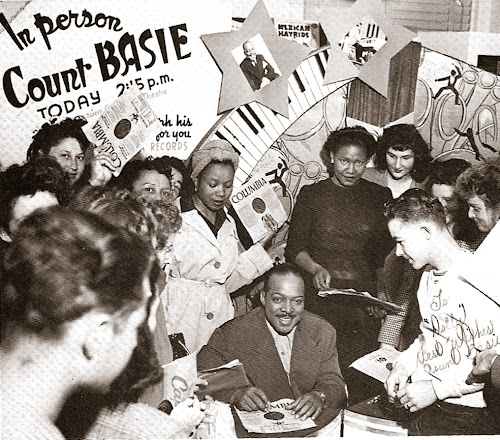
My first opportunity to see the great Count Basie came in 1972, when I was a college junior. The band came to Ithaca, NY, and played at a concert hall downtown that had opened to much fanfare a year earlier. I knew somebody working the door and got in for free. But I was deeply into the avant garde at the time and Basie was, well, old news. I hung around for fifteen minutes – long enough to say I'd seen the band – and then went off into the night to persue whatever it was that 20-something hippie children did in the night back then. Too bad, because that band was a killer group (as nearly all his bands were) with Eddie "Lockjaw" Davis back on tenor, Al Aarons on trumpet, Al Grey's trombone, and Eric Dixon and Charlie Fowlkes filling out the reed section.
My next chance to see the Kid from Redbank came eight years later at Chicago's massive annual jazz festival. A free event featuring a who's who of jazz stars over three days, the festival brought in the Count Basie Orchestra as the Saturday evening closer. This time I caught the whole show and loved it. The Count was ailing by then – he came on stage on one of those motorized chairs you see in grocery stores these days. But the band swung massively and rocked the huge crowd with the Loop's skyline in the background and a colossal, starry sky overhead.
Four years later, Basie was gone and the jazz world had lost the man who had taught the world to swing. Needless to say, I was very grateful I had been able to see him at the helm of his extraordinary organization.
![]() |
| Don Byas at a recording session in the mid-'40s. From A Pictorial History of Jazz |
Not there isn't plenty of star power here. Buddy Tate blows for Evans and the great Don Byas is in for Lester. Byas, who had scored a hit for Basie with his solo on "Harvard Blues," would go on from here to be a fixture on 52nd Street and the reed man in one of Dizzy Gillespie's first bebop combos. His duets with Slam Stewart at a 1945 Town Hall concert remain some of the most amazing performances in jazz history. On these sides, he gets ample solo space, and you can hear shades of things to come.
The tunes on this download aren't all that memorable, but the band plays them with verve and panasche. You get a real sense of the voluminous amount of material the Basie Band (and all the other swing groups) must have cycled through its book over the many years of its existence. Yet the guys continuously gave it their all, just as they do here. Inspirational!
This LP comes probably from some long-forgotten thrift store foray. It is one of three Basie reissues that came out in 1955 on Epic (the other two feature Lester Young). It's in excellent shape given its years, but Side 2 required a bit of cleaning up in places. I think you'll approve. The music in this download comes, as always, right from the original vinyl.
Basie's Back in Town
Count Basie and His Orchestra
Epic LN 3169
Basie, p; Ed Lewis, Al Killian, Buck Clayton, Harry Edison, tp; Dicky Wells, Ed Cuffee, Dan Minor, tbn; Earl Warren, Tab Smith, as; Buddy Tate, Don Byas, ts; Jack Washington, bar; Freddie Green, g; Walter Page, b; Jo Jones, d.
New York, NY; January 28, 1941
1. Jump the Blues Away
2. The Jitters
3. Tuesday at Ten
Omit Jones; add Kenny Clarke, d.
New York, NY; May 21, 1941
4. Down, Down, Down
5. Tune Town Shuffle
Omit Clarke, Wells, Minor; add Robert Scott, Eli Robinson, tbn; Jo Jones, d.
New York, NY; July 2, 1941
6. Basie Boogie
7. Diggin' for Dex
Omit Cuffee; add Dicky Wells, tbn.
New York, NY; September 24, 1941
8. Fiesta in Blue
Personnel as above, add Jimmy Mundy, arr.
New York, NY; October 1, 1941
9. Something New
Personnel as above.
New York, NY; November 3, 1941
10. Platterbrains
Omit Wells, Smith; add Ed Cuffee, tbn.
New York, NY; November 17, 1941
11. The Feather Merchant
12, Down for Double
Find it here: https://www.mediafire.com/?4defzv3h67vk222
Sunday, June 30, 2013
The Count at the World's Fair
Sometimes you come across the most amazing things in the most out-of-the-way places. A cliche, yes, but true enough. Here's yet another affirmation of it's shopworn validity.
![]() |
| Melby's Market, the general store at the crossroads in North Waterford. Bison burgers are the house specialty. |
At North Waterford's crossroads, we decided to go left. There were no signs, and no indication of anything like a fairgrounds. But then, half-a-mile up the road, there was a hand-painted, weather-beaten board proclaiming "Fair Parking" with an arrow pointing left up a dirt road that skirted around what appeared to be a dilapidated, abandoned chicken coop. Never shy about dirt roads, my parents veered up the hill, bouncing the car over ruts and stones and on into the woods.
![]() |
| The World's Fair's logo |
True to the claim in the classified ad in the paper, there was a flea market going on. A dozen sellers had set up tables in a few of the sheds, their wares piled on overturned cardboard boxes or arrayed on folding tables. It was a pretty meager showing, but we'd come that far, so we climbed out of the car. Romance novels, kiddie clothes, VCRs, kitchen gadgets, crocheted novelties, rusty tools – the usual stuff, being picked over by a few buyers. But then something caught my eye.
![]() |
| An artifact from the jazz world of December 1936 – Down Beat was still a monthly then. |
One of life's great (or not so great) mysteries.
The paper was in great shape with no tears and no pages missing. I paid a buck for it and spent the better part of an hour going through it back at my folk's place. Here were stories that mentioned Earl Hine's orchestra at the Grand Terrace in Chicago, a blurb about young trumpet upstart Roy Eldridge tearing it up over nightly network broadcasts, and a feature about Mildred Bailey and her new hubby, Red Norvo. Plus loads of great period advertisements, record reviews and nightclub listings. One thing that struck me: So many of the musicians mentioned I'd never heard of before. Shown on the mag's cover were Margie Lindt, Bob "Bazooka" Burns, Frankie Masters, Romo Vincent, Charlie Trotta, John O'Donell and many others. Who? I don't know, and history doesn't either.
But there was one fellow – a pianist – whom history hasn't forgotten. And the squib in Down Beat that mentions him is perhaps one of his first national press clippings. It's 32-year-old Bill Basie, nicknamed "Count," and it prominently features what the magazine claims is the first photo to be published of the band leader. Basie and the boys had been getting their road show together, playing at the Grand Terrace for an extended stay before heading to New York to record for Jack Kapp and the Decca label. John Hammond, who had discovered them when he chanced to hear a radio hookup from a Kansas City nightery, had tried to get them signed to Columbia. But Kapp had beaten him to the punch. So Hammond famously arranged to secretly record Basie in a small group (with Lester Young) while the band was in Chicago. Those sides were issued as by "Jones-Smith Incorporated," and they remain classics.
Though it took place just a few months earlier, there's no mention of that recording session in the article. But the orchestra gets a glowing review and Basie and his rhythm are rightly credited with being the finest in the nation. So I thought it only appropriate that Gems serve up a few examples of the Count at the piano to celebrate this bit of jazz history that serendipitously came my way in far-flung North Waterford, Maine.
This is a French release, consisting of rare airchecks and TV broadcasts – one of vast series of intriguing records that were issued by Musidisc in the 1970s. They're pretty common, but this one seems harder to find than others. The music here is extraordinary, with Basie providing what amounts to a primer on blues piano. There are also great solos by bassist Eddie Jones and even a "solo" from guitarist Freddie Green (on "Cute"). Wardell Gray is present, too, on one selection. "Nails" is a remarkable display of wry humor and subtle ensemble playing, not to be missed. The sound varies – tape hum being the worst of the defects – but the music, as always, is "keel-ling." And next time you're in the Lakes Region in Maine, check out the North Waterford World's Fair. You never know what you'll find ...
These files were ripped from the original vinyl with, in this case, no cleaning of the sound whatsoever.


The Soloist
Count Basie
Musidisc 30 JA 5204
Count Basie, p; various groups including Walter Page, Freddie Green, Jo Jones; Wardell Gray, Clark Terry, Marshall Royal; Eddie Jones, Sonny Payne; and others (see download for full personnel, dates).
Airchecks, TV broadcasts; New York, Paris, Zurich, San Francisco; Various dates, 1941-1967
1. There'll Be Some Changes Made
2. Rockin' Chair
3. Basie Boogie
4. Basie Boogie
5. Basie Boogie
6. Basie Blues
7. All of Me
8. Cute
9. Blues No. 2
10. Squeeze Me
11. Blues No. 1
12. Blues No. 3
13. As Long As I Live
14. Blues No. 4
15. Nails
Find it here: https://www.mediafire.com/?dxjy4lzlk4p3cc8
Monday, October 8, 2012
Goin' to Kansas City
It's my firm belief that the familiar swing of jazz – as we understand it today – came to us from the Tom Pendergast's Kansas City of the 1930s. Specifically, from the men and women who created an original sound in the city's many night clubs, dance halls, speakeasies and dives. Four beats to the measure never swung so hard.
![]() | |
| Here's impresario Gene Norman with a couple of wannabe starlets, digging the sounds of our offering for this posting. A typical period pose from the editors at Down Beat magazine. |
You hardcore collectors certainly know that all these tunes are available elsewhere – especially the familiar Basie numbers. But having them all in one place is a treat. You get a real feel for KC's hotbed musical environment. The two titles by Mary Lou are fairly obscure and feature terrific work from Shorty Baker (pre-Ellington, of course) and driving solos from long-forgotten Andy Kirk tenor star, Dick Wilson. Ms. Williams herself is in full command of the keyboard and her arrangement of "12th Street" occasionally foreshadows the developments of bop several years hence.
![]() |
| Gems' copy of the original release is a little worse for wear. We opted to use the LP version for the upload. |
Then there's Eddie Barefield's unattributed clarinet on "South" with Lips Page's pick-up band. That coupled with the leader's muted trumpet solo and Don Byas' still-developing tenor sound make the tune a classic. Pete Johnson's band rollicks through a tune named for the Kansas City Colored Musician's Union, Local No. 627, with the cast the same as for Lips' titles. Great Don Stovall here. Roll 'em, Pete!
The standout for this posting has to be the rare Durham sides. Not only do we get Eddie's advanced electric guitar work, but Buster Smith demonstrates why Bird's sound was compared to his in Parker's early days. And catch the soli toward the end of "Little Girl" – fabulous Durham writing and very tight playing by the guys.
Note that the liner notes for this LP refer to its selections as "dance compositions." Exactly right. This was music to move your feet to, and if you're like me your toes will be tapping. This is the music that taught the rest of the jazz world to swing. Mixed in, of course, were some of the greatest jazz statements by some of the music's greatest practitioners. You only have to catch the bookended solos by Hershel Evans and Prez on "Doggin' Around" to understand that.
So, download and roll back the rugs! As always, these tunes were ripped from the original vinyl with, in this case, no cleaning of the sound.
The standout for this posting has to be the rare Durham sides. Not only do we get Eddie's advanced electric guitar work, but Buster Smith demonstrates why Bird's sound was compared to his in Parker's early days. And catch the soli toward the end of "Little Girl" – fabulous Durham writing and very tight playing by the guys.
Note that the liner notes for this LP refer to its selections as "dance compositions." Exactly right. This was music to move your feet to, and if you're like me your toes will be tapping. This is the music that taught the rest of the jazz world to swing. Mixed in, of course, were some of the greatest jazz statements by some of the music's greatest practitioners. You only have to catch the bookended solos by Hershel Evans and Prez on "Doggin' Around" to understand that.
So, download and roll back the rugs! As always, these tunes were ripped from the original vinyl with, in this case, no cleaning of the sound.

Kansas City Jazz
Various GroupsPersonnel listed in download
Decca DL 8044
Pete Johnson's Band
November 11, 1940
1. 627 Stomp
Joe Turner and His Fly Cats
November 11, 1940
2. Piney Brown Blues
Mary Lou Williams and Her Kansas City Seven
November 18, 1940
3. Baby Dear
4. Harmony Blues
Andy Kirk and His Clouds of Joy
November 7, 1940
5. The Count
6. Twelfth Street Rag
Hot Lips Page and His Band
November 11, 1940
7. South
8. Lafayette
Count Basie and His Orchestra
August 9, 1937
9. Good Morning Blues
10. Doggin' Around Eddie Durham and His Band
November 11, 1940
11. Moten's Swing
12. I Want a Little Girl
Monday, December 26, 2011
All the Best!
Sunday, May 15, 2011
A Norman Granz Two-fer
In his characteristic short-crown fedora and sweater vest, Norman Granz is caught in rare repose by photographer and jazz writer Bill Gottlieb and his Speed Graphic. By the early '50s, when this photo was taken, Granz was the captain of jazz industry. Photo by William Gottlieb
I have two little EPs from the early days of the 45- and 33-rpm format and I was trying to come up with a way to post them here on Gems without forcing you, our esteemed visitor, to have to devote an entire CD to a paltry 15 minutes of music. Then an idea came to me – why not pair them under the unifying element of their producer, impresario Norman Granz? Works for me. Now you can download a more-efficient paltry 25 minutes of music.
But ... who was Norman Granz? Where to begin?
The originator of the "Jazz at the Philharmonic" concert concept, Granz was a Los Angeles native who pioneered integrated jazz shows in the forties, owned numerous successful record companies, managed top jazz talents, marketed national and international tours, and made the careers of jazz stars like Ella Fitzgerald and Oscar Peterson. A shrewd businessman in an industry rife with well-intentioned amateurs, Granz was to some a savior and prophet, to others a manipulative Machiavelli.
In the fifties, Norman would regularly buy spreads in multiple jazz publications touting his next JATP tour, or his star players' jazz poll victories, or his latest concept album ("The Jazz Scene" being the first in a series of high-priced "collector's items"). His name appended to a jazz concert usually guaranteed a capacity audience of hooting, whistling and "Go, man!"-screaming jazz maniacs. And he would frequently record the results and issue them in a never-ending series of albums (78 and 33 rpm) under the JATP rubric. With Norman, everybody made money.
The great Chicago jazz DJ, Dick Buckley, worked for a while for Granz in the mid-'50s. While he never really criticized his former boss on air, I heard Buckley more than once mention that Norman got rich while his stars wound up scuffling for nickels and dimes. I myself saw Norman as a commercializer, a guy more interested in making a buck than in making art. When Norman moved permanently to Switzerland in the early '60s, I remember thinking he probably wanted to be closer to his money.
All of which is beside the point. The guy did much to support the music and its artists, and these two EPs are evidence of the wonderful stuff that could be produced under his direction. I don't believe this music is currently available in digital form, though it was issued on several LPs back in the day.
Three of the four Basie tunes have the Count fronting a sextet featuring Joe Newman and Paul Quinichette. Quinichette is often dismissed as a Lester Young-wannabe, but to my ears he exhibits real individuality here. Lester never sounded like this. "Tippin'" is a big band performance with a nice solo from "Lockjaw" Davis, probably an Ernie Wilkins chart. This is Basie before the arrangers were brought in to make over the band, and they swing hard. That's the Redbank Kid with bassist Gene Ramey in the photo, by the way.
Bob Brookmeyer was a rising talent when this EP was issued. He'd been working with Stan Getz (another Granz property) at the time of this recording and had been in a number of top-level big bands including those of Woody Herman and Claude Thornhill. He's heard here with a West Coast rhythm section, playing perhaps a little too laid back by East Coast standards (these things mattered in the mid-'50s). Brookmeyer was unusual in that – unlike most trombonists of the day – he played a valve version of the horn. David Stone Martin thought otherwise – he shows Bob with a standard slide trombone on the cover. You can see Brookmeyer with the correct instrument in the picture.
As always, the files here were ripped directly from the originals with only a slight cleaning up of pops and clicks. Your choice as to whether the music gets filed under Basie or Brookmeyer. Or Granz, for that matter.
The Count Basie Sextet, Clef EP 186
Count Basie, org, p; Joe Newman, tp; Paul Quinichette, ts; Freddy Green, g; Gene Ramey, b; Buddy Rich, d.
New York, NY; December 13, 1952
*Count Basie, p; Renauld Jones, Paul Campbell, Joe Newman, Wendell Culley, tp; Henry Coker, Benny Powell, tbn; Marshall Royal, as, cl; Ernie Wilkins, as, ts; Eddie Davis, Paul Quinichette, ts; Charlie Fowlkes, bar; Freddy Green, g; Jimmy Lewis, b; Gus Johnson, d.
New York, NY; July 22, 1952
1. She’s Funny That Way 4:10
2. Tippin’ on the QT* 2:59
3. Count’s Organ Blues 3:09
4. As Long As I Live 3:09
2. Tippin’ on the QT* 2:59
3. Count’s Organ Blues 3:09
4. As Long As I Live 3:09
Bob Brookmeyer Plays Bob Brookmeyer, Clef EP 322
Brookmeyer, v tbn; Jimmy Rowles, p; Buddy Clark, b; Mel Lewis, d.
Los Angeles, CA; December 26, 1954
5. There Will Never Be Another You 4:23
6. Bulldog Blues 8:01
(Link fixed again!) Find it here: http://www.mediafire.com/download/cz8rr9d3km9ifuz/Norman_Granz_2-fer.rar
Subscribe to:
Posts (Atom)


