Showing posts with label Earl Hines. Show all posts

Sunday, November 15, 2015

Hines' History


You maybe have seen this on the Tube of You, but in case you haven't, you're in for a treat. Here's the great Fatha' Hines, the Earl of jazz piano, demonstrating the art of syncopated piano playing as it evolved through the decades. He should know, because he played a major role in its development. The Yale-looking fellow who does the introduction is Ralph J. Gleason, esteemed critic and jazz historian (later SF rock 'n' roll champion). I never liked him much, but Hines is extraordinary. Watch, and be awed. 

The show, by the way, is Gleason's "Jazz Casual," a TV program that ran on NET in the '60s. This clip probably ran in 1961 or '62, judging by Ralph's coif.

Monday, November 26, 2012

Hines' Varieties

On the ball: The Fatha takes a break from the keys to roll a few at the lanes. Very
nice form, don't you agree? This was taken about the time these recordings were
made. From "The World of Earl Hines"

Here's another Earl Hines offering – one that's a bit more contemporary than those of our previous postings. Hines has long been one of my favorite players, ever since I first heard his keyboard gymnastics on "Weather Bird" with Louis. His sense of rhythm was far more advance than any of his contemporaries, with the possible exception of James P. He just knocked me out!

I was filing away some records I'd pulled for my radio show when I came across this gem. It's another of those cheapo budget records from the early '60s, but it's not one that you see very often and the music reissued on it comes from an interesting period in Hines' career. Plus, these sides were all originally recorded for the short-lived Sunrise label in Chicago, making them pretty rare (back before the Internet, that is).

There's another reason why I decided to upload these files. The record has an interesting story behind it (are you surprised?). 

When I was living in Hyde Park on the south side of Chicago, I spent a lot of time in used record stores and thrift shops. There were great records to be found there as you might imagine, and I found quite a few. One day I purchased an LP with curious notes on its backside written in blue ballpoint pen ink. The notes added information on personnel, and on session dates and locations. They also commented on the various tunes on the LP – things like "Dynamite Blowing – a Real KICK!!!" and "Slow Burner – Tpt. Solo – Bold!!!" Whoever had made the notes used exclamation points freely.

A sample of the mysterious annotations, made
on a Duke Ellington record. The writer put much
effort into drawing lines and curious symbols.
I didn't think much of it until I came across another LP with similar jottings. And then another, and another. I began seeing dozens of records with the ballpoint marginalia in many of my record haunts. I decided that somebody was getting rid of a collection of primo jazz sides piece by piece, selling LPs to dealers as circumstances dictated. The variety of detailed information and the evaluations of the tunes (the writer had an elaborate system of stars and crosses for rating them) made me suspect that the original owner may have been a radio DJ. The notes served as a guide for picking material for his show on the fly – he wouldn't have to preview the music, just grab and go. 

I never found out the true story behind the ballpoint annotator, but I did end up with about thirty of his records. This Hines LP is one of them. The interesting thing about his notes is that he not only knows the correct date and place for Hines' Sunrise sessions, but he knows many of the players as well (more than are listed in my discography). The record itself offers no info whatsoever on the material. My question is this: How did this fellow know these things? Did he have the original Sunrise releases? Did he know one of the sidemen, or possibly Hines himself? Was he a serious hipster on the scene? This last hypothesis seems to be borne out in his liberal use of jive argot – as in "T-pipe" for "tenor saxophone."

Johnny Hartman
Whatever the case, we have here some rare Hines recordings that capture the Fatha in a period of transition. His big band had just been disbanded, a victim of changing tastes and shrinking budgets, and he'd just been hired by his former recording partner, Louis Armstrong, to be a sideman in Satchmo's first All-Stars unit. It must have been a difficult time for Earl. Victor was no longer recording him, so he went with Sunrise and issued a series of tunes in a variety of styles. In this download you'll hear the first gleanings of R&B, sweet ballads with strings and some straight-ahead jazz in the tradition. It's like Hines was hoping something would catch the public's ear but wasn't sure quite what.

The Dark Angel of the violin –
Eddie South
That said, you get to hear the immortal violinist Eddie South on three of these titles (and maybe more if, like me, you suspect it's Eddie South and not Bill Dougherty playing fiddle on some of the other tunes). You'll also hear the first recordings of a young up-and-coming baritone named Johnny Hartman, as fluid and smooth as he'd ever be even at age 24. Then there are the fine arrangements of Ernie Wilkins (or is it Budd Johnson?) on the big band sides. The jump tunes with Wini Brown feature a band pulled from Lionel Hampton's orchestra – with Mingus on bass! "Blues for Garroway," by the way, refers to Dave Garroway, then a nationally known Chicago radio personality and promoter of jazz. Earl no doubt was hoping Garroway would use the tune for his theme.

After 1947, Earl Hines would never again front an orchestra of his own on a permanent basis. Too bad, but then we wouldn't have his many decades of stellar trio and quartet work. So enjoy this last gasp of one Hines tradition. And see if the mysterious annotator doesn't inspire you to form your own theories about his story.

As always, these files were ripped from the original vinyl with just a mild cleaning of light pops and clicks.


Earl Hines and His Orchestra
Earl Hines
Hines, p; Morris Lane, ts; Eddie South, vi; Bob Wyatt, org; Ernest Ashley, g; unk. b, d.
Chicago, IL; December 1947

 
1. Honeysuckle Rose
2. Dark Eyes
3. Blues for Garroway

 
Hines, p; Duke Garette, tp; Bobby Plater, as; Morris Lane, ts; Charlie Fowlkes, bar; Bill Dougherty, vi; Bill Mackel, g; Charles Mingus, b; Curley Hamner, d; Wini Brown, unk., v.
Chicago, IL; December 1947

 
4. The Sheik of Araby
5. No Good Woman Blues

 
Hines, p; prob. Willie Cook, Vernon Smith, Fats Palmer, Charlie Anderson, tp; Bennie Green, Walter Harris, Gordon Alston, tbn; Clifton Small, tbn, p; Scoops Carey, Thomas Crump, as; Ernie Wilkins, Budd Johnson, ts; Wallace Brodis, bar; Bob Wyatt, org; unk., vbs; Skeeter Betts or Bill Mackel, g; Calvin Ponders, b; Gus Johnson, d; Johnny Hartman, Melrose Colbert, v; unk. string section.
Chicago, IL; late 1947

 
6. Ain’t Misbehavin’

 
Personnel as 4, 5:
7. Bow-legged Mama

 
Personnel as 6:
8. Black and Blue
9. I Need a Shoulder to Cry On

 
Personnel as 4, 5:
10. My Name Is on the Doorbell


Find it here: https://www.mediafire.com/?emw51rme3yyr1n2

Friday, September 30, 2011

Requiem for a Collector

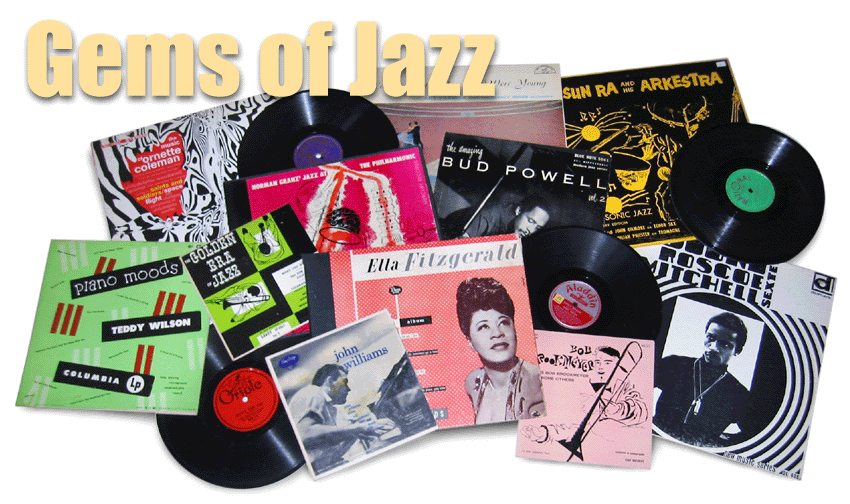
Here's just a small sampling of the many records included in what turned out to be a wonderful collection of '40s and '50s mainstream jazz. Yowzah! Photo by Gems of Jazz 
Like most citizens in this day and age, I have a day gig. Only, because I work for a newspaper, my day gig is frequently on the night shift. The news never sleeps, especially in the digital age. So that's me, driving back and forth to work, trying not to doze off long enough to wake up in a ditch at 1 a.m.

Every now and then I try to do something interesting to make the commute a bit more palatable. I'll take a different route or pick up something tasty for the ride or visit a local thrift store (if I can get off early). There's one shop I pass every day that's a bargain hunter's paradise. I've been in it several times over the years, and never have had the patience to see it all. Stuff everywhere. Too much stuff.

One day I was early for the job and the weather was right and I was in the mood. I pulled over in front of "Ye Olde Anything Store" and plunged in. "Any new records?" I asked its corpulent, grubby proprietor. "Records? Yeah, right out back, in the shed. Here's a light bulb for the lamp. It's pretty dark out there. Just screw it in."

Screw it in? He was right – it was dark. And musty. And FULL of records. The chicken coop-sized shed out back was a repository for vinyl. The bulb helped a little, and after my eyes adjusted I could see pretty well. I went through several stacks without much luck. Mostly those annoying LP-sized disco singles. And record jackets with no records.

On the floor amid the piles was one of those big blue plastic recycling tubs that we have here in New York. Sticking up from one end of the tub was something that got my attention. It was the corner of a pink Mylar sleeve – the kind of sleeve that American Recording Society LPs came in. Jazz LPs.

I pulled it out and checked. "Billie Holiday Sings," ARS G-409. In mint condition. Lucky me! Then I noticed that there were 50 or 60 more just like it in that blue tub. Hoo-boy.

I pulled what I could and settled up with the grubby fellow out front. The score amounted to 57 records, all American Recording Society sides, all with their accompanying booklets. All great jazz. The man wanted a buck a piece for them, but took $55. I went off to work, thinking of other things.

A week later I went back to "Anything" and really went through everything. Not only did the guy have records in the shed, he had some in the cellar of the main house and farther out back under a big tent. I found several hundred additional sides, nearly all in pristine shape. And all, it turned out, from a single collection.

How did I know? Nearly every one of the records I pulled from the pile had a name stamped on the back cover. "J.J. Chambers" it said. Mr. Chambers clearly loved traditional jazz, and he took special care of his records. Judging by the nearly complete set of ARS sides, he must have belonged to a few record clubs. American Recording Society albums were repressings of Verve discs, all sanctioned by Norman Granz and only available by mail. And they all had liner notes in booklet form – something the originals lacked. Mr. Chambers' collection also included a large quantity of Jazztones LPs – another '50s record club product. There was also a nearly complete set of George Shearing records, evidence that J.J. may have belonged to a Capitol record club as well.

The backs of several of the records had address stickers attached  – the kind you get with junk mail solicitations. J.J. Chambers clearly lived nearby the "Anything" store. In fact, he lived on a side street that was on my route to work. I'd been going by his house every day for nearly seven years. It was an unassuming box-like structure, sided in baby blue aluminum clapboards with overgrown boxwood bushes out front. An inauspicious abode for a swinging jazz fan ...

One of my editors lives on the same street, and it turned out she vaguely remembered J.J. Chambers. He was as an elderly man she'd see occasionally out in front of the house. She thought he may have died several years ago. His son was now caring for the place and slowly cleaning it out. That's when the "Anything" store entered the picture. And yours truly soon after.

So ... as a tribute to a fellow collector and to the fine body of American jazz he amassed and was at pains to preserve, I offer these recordings from his trove for your listening pleasure.

Both of these discs are 10-inchers. One is on the cheapo Royale label, usually a budget label of dubious quality. But this one features all six sides from Earl Hines' very first session under his own name, originally recorded for QRS in Chicago. I know of no other issue for these historic sides other than the original 78s and this budget 10-inch pressing. Fabulous stuff, recorded just six months after Hines and Louis Armstrong waxed their superb Hot Five titles. You won't find these tunes anywhere else today.

The other LP is a sampler on the Jazztone label – the only 10-inch record they ever issued. It's as rare as hens' teeth, and though the music is mostly all available today in other forms, it's too cool not to include here. Plus the tunes make for great listening. One interesting note – the Rex Stewart cut features one "Herb Nichols" on piano, better known as Herbie Nichols. Nichols was, of course, the modernist whose recordings for Blue Note were later very influential, but whose lack of financial success forced him to earn a living playing in trad bands. Here he is, doing just that.

As always, these sides were ripped from the original vinyl, with only a minor cleaning of the sound.


Great Jazz Piano Solos, Royale 18166
Earl Hines, p.
Chicago, IL; December 8, 1928 (Originally on QRS)

1. Stowaway
2. Just Too Soon
3. Chicago High Life
4. A Monday Date
5. Off Times Blues
6. Panther Rag

Jazz Sampler, Jazztone J-SPEC 100
(Personnel in download)

7. Darling Nellie Gray (Sidney Bechet with Wally Bishop)
8. Slam Slam Blues (Red Norvo w/Charlie Parker, Dizzy Gillespie)
9. Relaxin' at Camarillo (Charlie Parker)
10. Dark Eyes (Art Tatum)
11. B.C. Blues (Buck Clayton)
12. Honeysuckle Rose (Coleman Hawkins)
13. Bad Actin' Woman (Jack Teagarden)
14. Trio (Erroll Garner)
15. Moon Burns (Woody Herman Woodchoppers)
16. Basin Street Blues (Rex Stewart Dixieland Band)

Find them here: http://www.mediafire.com/download/08vu1hpy8hdcxcy/hinesjazztone.rar
Tuesday, November 9, 2010

Piano Moods: Earl Hines

Earl Hines and stogie perform in a New York City club in 1952. Photo by Tom James

Here's Earl Hines after he'd abandoned the big band and had quit Louis Armstrong's first all-star group. He was working mostly in trio and quartet settings at the time and, judging by trade magazines from the period, was keeping a pretty low profile.

Columbia Records was experimenting with long-playing 33 1/3-rpm records, and decided to issue a series of "extended play" albums – 10-inch discs – featuring pianists. Hines was one of them. What was unusual about these records was that there were no pauses or separations between tunes – each side of the EP was one continuous performance.

In keeping with the marketing angle, the performances on these albums are unchallenging and fairly perfunctory. But there are stellar moments, and Earl Hines demonstrates his great skill on "I Hadn't Anyone But You" and breaks into some surprising Latin rhythms on "Diane."

This album is a thrift shop find, one of several interesting records discovered among hundreds crammed into a shopping cart doing duty as a record rack. It was hell to look through but well worth the effort, as it turned out.

As always, the music in this posting was ripped from the original vinyl with no enhancement other than a mild cleaning up of minor clicks and pops.


Earl Hines, piano
Al McKibbon, bass
J.C. Heard, drums
New York, NY; July 17, 1950
Columbia CL 6171 (7" extended play record) 

1. Rosetta
2. When I Dream of You
3. You Can Depend on Me
4. Diane
5. Velvet Moon
6. I Hadn't Anyone But You
7. These Foolish Things
8. Deed I Do