Friday, November 1, 2013

The Philadelphia Sound

Instructor Bill Barron offers a few pointers on clarinet technique during a class at the Brooklyn Children’s Museum in 1972. By the early '70s, Bill had pretty much left the New York scene and was headed for a successful second career in academe. BCM photo

A blogger friend got in touch and wanted to know if I had a particular album by the late composer, teacher and reed player Bill Barron. When I said I did, he asked that I digitize it and send him a copy. No problem, says I – and then I decided I might as well also post the result for all our visitors here at Gems. Two birds with one stone – or one upload.

Bill Barron has long been one of my favorite tenor players. I first became aware of him when I came across a beat-up copy of his seminal recording "Modern Windows" on Savoy in a thrift shop in Cambridge. His use of dense harmonies and chromatic melodies wrapped in fiercely driving rhythms brought to mind the sonorities of Cecil Taylor or John Coltrane. I suppose that shouldn't have surprised me as Bill played with Cecil (briefly) and was Coltrane's roommate in Philadelphia in the '40s when they were both starting out.


Bill and Ted's excellent adventure in music:
Messers. Curson and Barron in the early '60s.
But though Barron's music sounded out, it also remained in. Bill never went completely free. For half a decade he teamed up with the late trumpeter Ted Curson and experimented in an Ornette mode, always writing and arranging in a forward-thinking fashion. The Curson/Barron quartet made some of the best music of the '60s, though few jazz fans are aware of that today. You only have to sample "Tears for Dolphy" on Freedom and I think you'll agree.

The same year the photo above was taken, Bill Barron recorded the album offered here. He was already devoting much of his time and energy to teaching, and in 1975 received his doctorate in education from the University of Massachusetts. Several years later he was chairman of the music school at Wesleyan University in Connecticut. That's where I was fortunate enough to meet him.

Bill was a reserved man, quiet and thoughtful. Though he could be quite humble, he also had a dignity about him that let you know you were in the presence of a master. I saw him perform numerous times on campus and off and he was always superb. His lines were never "pretty" or superficial; he had a distinctive sound that took a little getting used to because it was so sinewy. But once it was in your ear, he never let you down. I think you'll find that to be the case with this record.


"Motivation" is a late recording for the Savoy Records label, done in 1972. It features Bill's younger half-brother, Kenny Barron, on piano along with his good friend, Chris White, on bass. The drummer is Al Hicks. The tunes are all Barron originals, with the exception of "Cosmos," which is by Kenny.


As always, the music in these files comes from the original vinyl. There was no cleaning of the sound required. These are .wav files, so they'll take a while to download.


By the way, my jazz blog friend, Hector, has a very fine site called Quintaesencia. He offers some very nice downloads, and you can brush up on your Spanish when you visit.


Motivation
Bill Barron Quartet
Savoy 12303

Bill Barron, ts; Kenny Barron, p; Chris White, b; Al Hicks, d.
New York, NY; 1972

1. Motivation
2. Land of Sunshine
3. Blues for R.A.
4. Cosmos (Kenny Barron)
5. Hold Back Tomorrow
6. Mental Vibrations

All composition except 4. by Bill Barron.

Find it here: https://www.mediafire.com/?8vnwc3q1jx0wrae

Tuesday, October 22, 2013

Boris Boots Monk

Monk in San Francisco, about to record for Riverside and accompanied by a mirthful Pannonica deKoenigswarter, popsicle and SF Chronicle in hand. Wonder what Monk has just said? William Claxton photo

Here's that bootleg I mentioned a couple of posts ago. A late offering for Monk's (now long-passed) birthday, we'll call it. A friend and visitor saw my reference to the Boris Rose bootleg which gave that earlier Monk posting its title, and he asked if I could upload the recording. Well, the way it works here at Gems is ... your wish is my command. So here 'tis.

The dapper Mr. Rose in his
later years.
But who is Boris Rose, you ask? Long-time collectors know the name because he was one of the original bootleggers of jazz material on a large scale. That was because he was one of the most obsessive documenters of jazz in the history of the music. From the mid-'40s right up until the 1990s, Mr. Rose recorded music and spoken word programs off radio and television broadcasts at an astounding rate. In the late '60s, he began to release some of the more historic tape recordings on his own highly idiosyncratic record labels. By 1969, you couldn't go into a reasonably large record store in any major city without encountering a raft of Rose product. You'd recognize them by their simple line-art, black-and-white covers, oddball titles and sketchy liner notes (when there were any notes at all). The music they contained was often some of the best by some of jazz's greatest artists, but their production quality was iffy, the editing amateurish and the recording info often wrong (sometimes purposefully so).

Needless to say, I collected as many Rose records as I could back in those days, and this Monk release is one of the best of them. There are no real surprises here: Monk is his usual superlative self, and John Ore and Frankie Dunlop keep a lid on things with aplomb. Charlie Rouse, one of the unheralded greats on tenor, takes some wild liberties with the High Priest's melodies while the leader lays out. Too bad he stayed so long buried under Monk's genius. I wonder what Rouse would have done if he'd followed his own muse?

Daughter Elaine Rose with Boris' picture and a sampling
of his massive tape archive. Wall Street Journal photo
A few more words about Boris Rose. The gent died in 2000, leaving his vast archive of tapes, acetates and records in the basement of his house in Brooklyn. I'd always heard he lived in a railroad flat on the Lower East Side that was filled to the ceilings with musty tape boxes, but it was not so. He was a compulsive recordist, but he was also compulsively organized in cataloging and storing his treasures. His holdings were so great that they hadn't even been cataloged by 2010 when his daughters were trying desperately to find someone or some institution to take the collection off their hands. I don't know if they succeeded, but you can read about their efforts here. And here's a quirky video that critic and author Will Friedwald made of his visit to the archive in Brooklyn (I always imagined Friedwald to be a rangy, cowpoke sort of fellow – boy, was I wrong).


Of course, one of the great problems with a collection like the Rose archive is the copyright issue. Who owns the rights to all that recorded material? And if any of it is ever to be released, how will the producers properly compensate the artists and ASCAP, BMI and all the rest? These were niceties that never troubled Boris. He just put stuff out, collected two bucks for each LP and kept recording.

Kind of like what we bloggers do today (except for the two-bucks part).

But whatever the fate of the Rose archives, this is one of its better documents. I've left his clipped starts and stops in so you can savior the full Boris Rose effect. Otherwise, the sound on the record is pretty much just the way it was way back in 1963 when Monk spent a few nights broadcasting from Birdland. Thanks, Boris!


Spastic and Personal 
Thelonious Monk
Alto AL 725
Thelonious Monk, p; Charlie Rouse, ts;
John Ore, b; Frankie Dunlop, d.
March 9, 16, 23, 1963; Birdland, New York, NY

1. Bright Mississippi
2. Epistrophy
3. ‘Round Midnight
4. Sweet and Lovely
5. Evidence


Find it here: https://www.mediafire.com/?tq3tcc37t4k6xhb

Saturday, October 19, 2013

Moody's Gamut

James Moody was one of the first modernists to seriously take up the flute and he proved to be as facile on that instrument as he was on tenor and alto. Bob Parent photo

I picked this record up many years ago in a basement used record shop in Hyde Park when I was living in Chicago. I got it along with a pile of Andrew White's self-produced LPs. Needless to say, I've listened more often to this James Moody effort than to any of those sides by the DC saxophonist.

Mr. Moody's output was prodigious, and this album is just one of scores he produced in the 1960s. But I'm including it here because it's so darn good. Recorded in 1964, it was one of two Moody did for for the independent Sceptor label, the one that featured the immortal Thad Jones. The album unfortunately fell through the critical cracks and disappeared from the label's soul-and-pop catalog after only a few years. But "Running the Gamut" is in the Gems archive and I think it's definitely worth an upload.

Trumpet master Thad Jones during a Blue Note recording
date, about a decade earlier. Francis Wolff photo
James Moody started out playing in Dizzy Gillespie's big band and proved to be such a powerhouse soloist that he soon was recording on his own for Blue Note. A trip to Sweden and an incidental 1949 date with local musicians resulted in a variation on "I'm in the Mood for Love" that became a smash hit when King Pleasure re-recorded it in '52 with lyrics for Prestige. After that, Moody was pretty much pigeon-holed as soloist single, fronting nameless groups for studio dates in a seemingly never-ending quest for a follow-up to "Mood." It was only in the late '50s, after Moody emerged from rehab due to alcoholism, that he began to find his own voice.

This date comes after James' long stint with the Chess/Argo label, and it places him in a post-hard bop, New York-style setting. Thad Jones had just left Basie and was about to launch his monster big band with Mel Lewis, and he's in top form here. Patti Bown is the pianist, and she's another of those journeyman jazz players who recorded frequently and exhibited real ability but never got much notice. I met her once in later years when she was living in the Westbeth Houses on Bethune St. in Manhattan and she was a big woman with an impressive, quiet presence. On "Gamut" she struggles with a sour-sounding piano and eventually comes up the winner. Youngsters Reggie Workman and Tootie Heath round out the section, providing the date with its progressive edge.


Ms. Bown, in a studio shot that was featured on the
cover of the only recording under her own name,
"Patti Bown Plays Big Piano," on Columbia.
Of the tunes, most are boppish, thoroughly modern sounding vehicles with lots of soloing space for the stars. One is entirely different – "If You Grin." A funk vamp, it features Patti Bown on organ, creating a sort of soul drone. To my ears, the tune anticipates what Miles would be doing half a decade later. A vocalist – a "thrush from Philly," as the liner notes put it – adds color to the ballad "Paint the Town Red." Marie Volpe (or Volpee – the record has it both ways) is unknown to me, but she has a nice head voice with a quivering vibrato. She also appeared on Moody's second Scepter release and then dropped out of sight.

The opening selection, "Buster's Last Stand," breaks down at the end, with the band bursting into laughter and Tootie tossing his sticks on the floor (clearly audible). What's so funny? Your guess is as good as mine, but the legendary Chicago DJ Dick Buckley use to claim it was because the band could no longer stand the out-of-tune piano that Bown was comping on. Give a listen and see what you think.

As always, this gem comes straight from the original vinyl and required no cleaning at all.


Running the Gamut
James Moody
Scepter S 525
James Moody, ts, fl, as; Thad Jones, tp; Patti Bown, p;
Reggie Workman, b; Albert Heath, d; Marie Volpe, v*.
August 1, 4, 1964, New York, NY

1. Buster’s Last Stand (Thad Jones)
2. Paint the Town Red
3. Em Prean Shore (Dennis Sandole)
4. Capers (Tom MacIntosh)
5. If You Grin (You’re In)
6. The Wayward Plaint (Dennis Sandole)
7. Figurine (Dennis Sandole)


Find it here: https://www.mediafire.com/?01f5jgsp733liao

Thursday, October 10, 2013

Spastic and Personal

A modest marker for one of the giants of modern music, and his life-long partner, Nellie, and their daughter, Boo-Boo.

Today is the 96th birthday anniversary of Thelonious Sphere Monk, surely one of the most idiosyncratic artists to create aural vibrations in the last century. A few years ago a friend gave me the photo above, taken on a fall day at the Ferncliff Cemetary in Hartsdale, NY. I was cleaning out my desk at work this afternoon and – purely by chance – I came across it. Maybe it wasn't by chance, who knows? Anyway, WKCR is running its annual Monk festival and it is a study in pure genius. You only have to listen to Monk's deconstruction of the blues on "Bag's Groove" from the "Miles Davis and the Jazz Giants" date on Prestige. That's minimalism like Philip Glass never imagined!

The title for this entry, by the way, comes from the name Boris Rose gave to one of his bootlegs, a 1963 broadcast that Monk made from Birdland. I ought to post that one here on Gems one of these days. Meanwhile, keep your corners bright when coming on the Hudson. Bye-ya!

Saturday, September 28, 2013

12 by George

That's Shearing you're hearing ... the quintet in Hollywood, 1952, around the time of the recordings below. From left, Al McKibbon, George, Denzil Best, Dick Garcia (a guess) and Joe Roland. Photo from songbook1.wordpress.com

Call this a guilty-pleasure posting. I've always loved George Shearing's music, even though much of it is – in my unbiased opinion – pop schlock. His stuff on Capitol devolved into spurts of tidy piano interspersed between tedious string arrangements and woo-woo vocal choirs. I have about thirty of his recordings on that label and I never listen to those (how I got them is a long story). But I do listen to the sessions Shearing and the quintet did for MGM. They're something else altogether.

Shearing speaks at the dedication of a new 
wing at the Hadley School in 1968. He'd briefly
attended the institution a decade earlier. At
the time, I was living a 
few blocks away in the
village of Winnetka.
By the time George Shearing got to America from his native England in 1947, he was already considered an accomplished jazz pianist. He'd already recorded for Leonard Feather, and in 1949 his performance of "September in the Rain" on MGM sold nearly a million copies. Whether he got his "locked hands" style of soloing from Lionel Hampton's pianist, Milt Bucker, or whether he thought it up himself is beside the point. Shearing soon became associated with that distinctive sound, and his many, many records for MGM serve up numerous examples of it. They are formulaic, to be sure, with the melody invariably played in unison by piano, guitar and vibes, but the tight ensemble work, light touch and succinct virtuosity convey a kind of jazz urbanity that is unique in the music.

A George Shearing record and cocktails really do seem to go together.

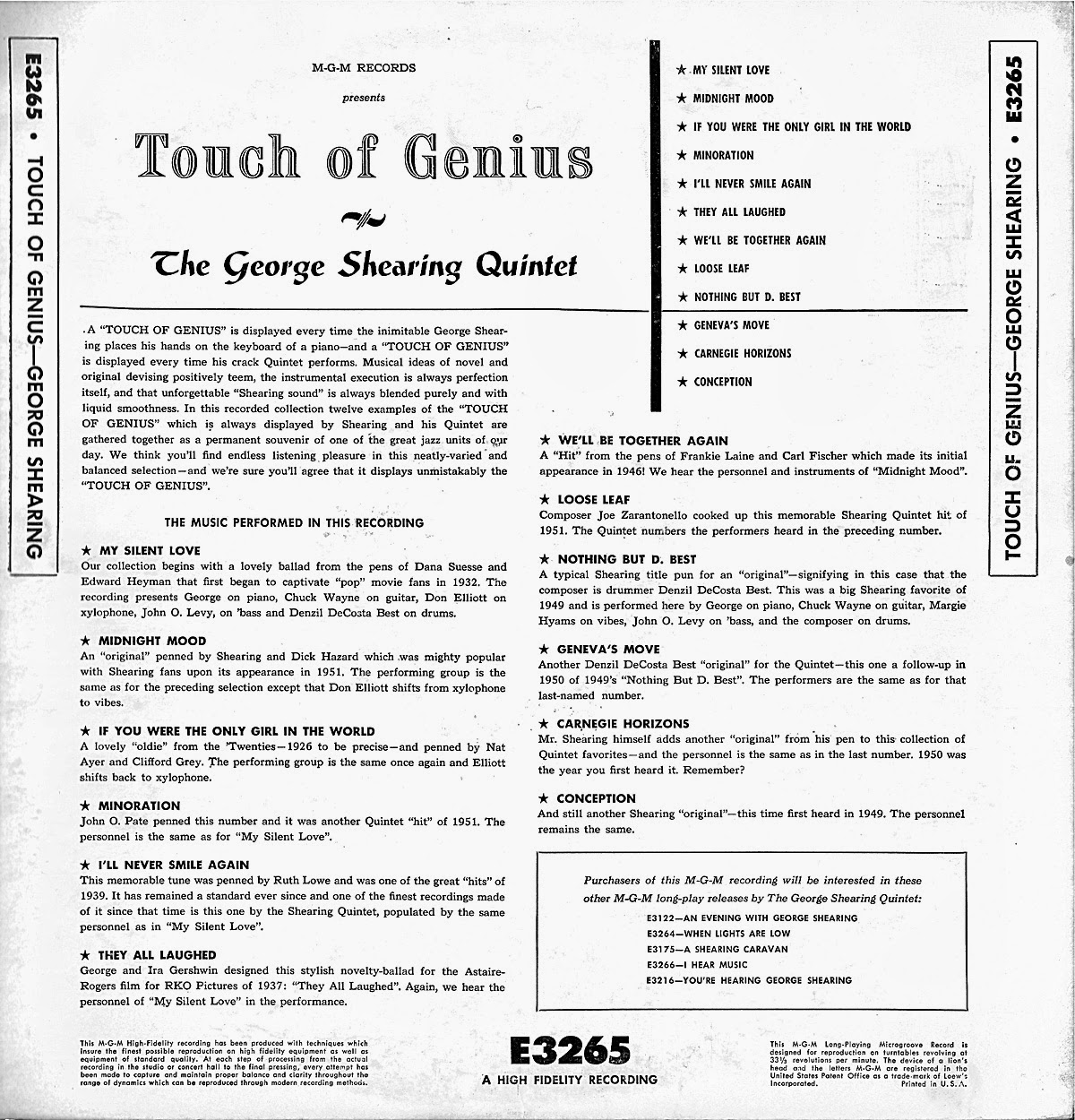
So here's my favorite George Shearing album. It's one of five LPs he issued on MGM, culled mostly from his earlier 78 rpm releases. It's a comfortable mix of romantic pop ballads and bop-oriented originals. The personnel varies a bit, but it's mostly Don Elliott on vibes (also an accomplished mellophone and trumpet player) and Chuck Wayne on guitar. Give a listen, and I think you'll hear why King Pleasure immortalized Shearing in his lyrics to Lester Young's "Jumpin' with Symphony Sid."

As always, these files were dubbed directly from the vinyl with just a little cleaning of the sound. Sorry for the heavy ring wear on the cover, but I was too lazy to Photoshop it out. Note that the order of the tunes is incorrect on the cover but has been fixed below.


Touch of Genius
George Shearing Quintet
MGM E3265
George Shearing, p; Don Elliott, xyl, vbs; Chuck Wayne, g; John Levy, b; Denzil Best, d. New York, NY; February 5, 7, 1951

1. My Silent Love
2. Midnight Mood (Shearing)
3. If You Were the Only Girl in the World
4. Minoration (Johnny Pate)

Marjorie Hyams, vbs, replaces Elliott.
New York, NY; June 28, 1949

5. Nothing but D Best (Denzil Best)

Personnel as above.
New York, NY; July 5, 1950

6. Geneva's Move (Denzil Best)

Personnel, date as 1.

7. I'll Never Smile Again

Personnel as 1.
New York, NY; February 7, 1951

8. They All Laughed

Al McKibbon, b, replaces Levy.
New York, NY; May 16, 1951

9. We'll Be Together Again

Personnel as 1.
New York, NY; February 7, 1951

10. Loose Leaf

Personnel as 1, Marjorie Hyams, vbs, replaces Elliott.
New York, NY; December 12, 1949

11. Carnegie Horizons (Shearing)

Personnel as above.
New York, NY; July 27, 1949

12. Conception (Shearing)

Find it here: https://www.mediafire.com/?7mbp4vxm9fi8zcq

Monday, September 23, 2013

National Holiday

Tenor master class: Coltrane, center, at the recording session for Johnny Griffin's Blue Note album "Blowing Session." Griff is on the left, and rounding out the section is Blue Note regular, Hank Mobley. The date is April 6, 1957. Photo by Francis Wolfe

Happy birthday to John Coltrane, born 87 years ago on this date. The current administration in Washington, DC, has asked the management here at Gems of Jazz to announce that today has officially been declared a national holiday. Everybody is urged to stay home from work and play "Chasin' the Trane" from "Live at the Village Vanguard" as loud as possible!

File (un)Sharing

RapidShare: New and unimproved, right.

Well gang, our pals at the dreaded RapidShare have once again morphed their service into something else, leaving all previous files that had been laboriously uploaded to their server in the unlinked digital dust. If you're interested, you can read a little about their current shenanigans here.

What this means for Gems users is simply this: None of the links on previous posts work. So the Board of Trustees here at Gems (namely, yours truly) has made an executive decision. Gems will relink the last dozen or so posts, so they should be available again soon. If you're interested in some of the older stuff, send us a request and we'll get you the link.

Sorry about all this, but when you use free services like Gems does you're at the mercy of those providing the service. Grrrr!

Update: Take courage, Gems users! All broken Rapidshare links have been repaired (I think). Those that were hosted by Mediafire remain with that file-sharing site. So you should be good to go – until the next time that these sites decide to mess with a good thing, that is.