Monday, September 23, 2013

File (un)Sharing

RapidShare: New and unimproved, right.

Well gang, our pals at the dreaded RapidShare have once again morphed their service into something else, leaving all previous files that had been laboriously uploaded to their server in the unlinked digital dust. If you're interested, you can read a little about their current shenanigans here.

What this means for Gems users is simply this: None of the links on previous posts work. So the Board of Trustees here at Gems (namely, yours truly) has made an executive decision. Gems will relink the last dozen or so posts, so they should be available again soon. If you're interested in some of the older stuff, send us a request and we'll get you the link.

Sorry about all this, but when you use free services like Gems does you're at the mercy of those providing the service. Grrrr!

Update: Take courage, Gems users! All broken Rapidshare links have been repaired (I think). Those that were hosted by Mediafire remain with that file-sharing site. So you should be good to go – until the next time that these sites decide to mess with a good thing, that is.

Monday, September 9, 2013

Marzette the Obscure

From the liner notes to Marzette Watts' other recording, a photo of multiple exposures showing the artist/musician standing in front of one of his paintings, tenor at the ready. Photo from "Marzette Watts and Company," ESP

Long-time visitors to this blog know that as a college student I worked in a Discount Records store in upstate New York. Those were the days when recorded jazz was in serious remission. The heyday of the great independent jazz labels (Blue Note, Prestige, Riverside) had passed and the majors were mostly focusing on mining the huge profits that could be made from "progressive" rock. Things were so bad that the Schwann Catalog listed only one Charlie Parker record in print. I kid you not.

Most record stores in the 1970s had vast
quantities of cut-out records for sale, usually –
as in this photo – at the back of the store.
It was also a time when a dedicated jazz record hunter could find fabulous treasure in the cut-out bins that every record store invariably had. My store had three rows of them filled with remaindered and overstock LPs, most for ninety-nine cents. Among the items offered were dozens of Atlantic jazz LPs – including a large part of the MJQ's discography – plus a few Riverside odds and ends (Barry Harris, Yusef Lateef, Mark Murphy).

We also had the entire BYG Actuel series with Braxton, the AEC, Archie Shepp and Clifford Thornton. Being enamored of the avant garde, I was most interested in those and any other "outre" LPs in our melange of cut-outs. One record caught my eye because of its striking cover. There was only one copy in the bins and it was a bit worse for wear with torn shrink wrap and a partially split cover. It was entitled "Marzette."


We were allowed as Discount Records employees to open any record in the shop for in-store play.I had of cache of sides I liked to listen to while ringing out customers, and I added "Marzette" to them. From the liner notes, I gathered that Marzette Watts was a painter/film maker who also played tenor. He was evidently pals with Bill Dixon, a horn player and composer I knew from his association with Archie Shepp. The music was typical "free jazz" of the period, not terribly together and not very good. Watts was, in my twenty-something judgment, a fairly mediocre saxophonist. I would put the record on when I wanted to drive customers looking for the latest Allman Brothers or Carole King album out of the store.


Even though I didn't think much of "Marzette," I eventually bought if (for all of four bits, at the employee discount) and took it home. It's been on the shelf now for forty years, pretty much unlistened to since those college days. But not long ago I was tootling around the Interwebs and I came across a copy of "Marzette" that had sold at auction for $350. Surprise!


Ms. Waters in her ESP days.
Turns out that Marzette Watts recordings are very desirable on the collectors market. "Marzette" garners top prices in part because it features cult chanteuse Patty Waters on one cut. She offers a breathy interpretation of Ornette's seminal "Lonely Woman," perhaps singing lyrics that she herself wrote. The late Bill Dixon is also present, playing piano on a composition that he wrote called "octobersong," no doubt inspired by the October Revolution that he help to foment several years earlier. And there's another Ornette tune – "Play It Straight" – that Coleman recorded live for Blue Note but has never been released.

On relistening to "Marzette," I'm still not much impressed by Watts' playing or the record. But it does have a nice energy in places and Bobby Fews and J.C. Moses contribute much to whatever coherence the album has. Because it's so unaccountably sought after, I thought I'd post it here so that you Gems fans can decide for yourselves.


Mr. Watts, by the way, studied painting at the Sorbonne in Paris in the early sixties before hooking up with Clifford Thornton and recording his first LP for ESP in 1966. His painter's loft was a hangout for many on the avant garde's front line – Shepp, Don Cherry, Ornette, Cecil Taylor and Pharaoh Sanders among them. In 1968 he recorded "Marzette" for Savoy, at a time when the label had abandoned jazz almost completely and was concentrating on gospel music. As a result, the album sold only a handful of copies and was soon relegated to bargain bins. Like Bill Dixon, Watts later briefly taught at Weslyan in Middletown, CT, presumably in music. Watts eventually quit music altogether and concentrated on art and film making. He died on the West Coast in 1998.


So here's the Marzette Watts Ensemble as produced by Bill Dixon, in all its obscure glory. These files were taken right from the vinyl, of course, with no cleaning of the sound required. Gems has saved you a cool 350 clams!


Marzette
The Marzette Watts Ensemble
Marzette Watts, ts; George Turner, cnt; Marty Cook, tbn; Frank Kipers, vln; Robert Fews, p; Juny Booth, Steve Tintweiss, Cevera Jehers, b; Tom Berge, J.C. Moses, d; Amy Shaeffer, Patty Waters, v. Bill Dixon, prod.
New York, NY; 1968; Savoy MG-12193

1. octobersong (Dixon)

2. Play It Straight (Coleman)
3. F.L.O.A.R.S.S. ((Watts)
4. Medley (Watts)
5. Lonely Woman (Coleman)
6. Joudpoo (Watts)

Find it here: 
https://www.mediafire.com/?0y4z5i6ddu6j6ci

Tuesday, September 3, 2013

88s on 78

Burning up the keys: Johnny Gaurnieri accompanied by drummer Sam Weiss and "singing bass" player Slam Stewart. Gaurnieri was the consummate session man in the mid-'40s but this is one of the few recordings he made under his own name. Photo by Gems

Old technology tends to pile up around the Gems household. Particularly when the venerable technology is in the form of shellac platters. I've been meaning to upload dubs of some of Gems' hundreds of 78-rpm recordings for a while, and finally some spare time has arrived with the end of summer. So here's hodgepodge of interesting stuff, some of it extremely rare, some available on compilations, but all of it great jazz of the pianistic variety.

Leading off the program is Hazel Meyers, a little-known singer who had a career primarily on the Vaudeville stage. But here she sings some topical blues in a convincing manner, with the great Fletcher Henderson accompanying. Of special interest on these performances are the excellent muted cornet fills by the legendary Joe Smith, a musician whose work with Bessie Smith we all know.

There's also Duke Ellington and the boys doing "St. Louis Blues" on a 12-inch Columbia disc. Nothing too unusual about that, except that the vocalist is a crooner named Bing Crosby. I had no idea the Duke and Bing ever got together, but here's the evidence (and Bing scats a chorus just to prove he's no square as the piece closes). 

Clarence Profit was a New York swing pianist who spent some time in the Caribbean. He's all but unknown today, but in the '30s and early '40s he was thought of in the same class as Teddy Wilson. He recorded this date for Decca in 1940, four years before his death at age 32. 

The Joe Bushkin date features a young Zoot Sims on tenor. If you're a drinker, don't miss Johnny Gaurnieri's "Hangover" – it'll give you a hangover just listening. Herman Chittison was another talented swing player who fell through the historical cracks. He recorded a number of well-received 10-inch albums for Columbia in the '50s, but this is one of his earliest dates. Continuing with obscure pianists, Cyril Haynes was completely unknown to me when I came upon his Comet recording. He worked mostly in New York and was with the Savoy Sultans for a time, but here he's joined by Dick Vance from Andy Kirk's band and the great Don Byas. 

Pat Flowers was a Fats Waller devotee, even recruiting some of Fats' original band members after Waller passed. Flowers is usually dismissed as an imitator, but he sounds good to me on this Majestic date. Hazel Scott reprises her spot in the movie "Rhapsody in Blue" with a bit of nice piano and a stiffish vocal on a Gershwin classic (the movie was about George's rise to fame).

Avery Parrish, Erskine Hawkins' pianist, revisits his hit "After Hours" on a Dud Bascomb selection (Bascomb was also in the Hawkins band), and we get to hear Earl Hines leading a thoroughly modern-sounding big band on a rare ARA recording. Erroll Garner plays his inimitable style on a couple of tunes on the virtually unknown Acorn label. 

Count Basie's up next with a couple of sides done for Norman Granz. These have been reissued, but I've included them because they're so tasty I couldn't resist. Finally, it's the Lion with a blues and a chestnut, swinging hard in post-stride fashion. His is the only record I've ever seen on the Blue Circle label. 

Speaking of labels, here's a sampling:


As always, these files were dubbed from the originals with just a minimum of cleaning and editing. So be prepared for surface hiss and slight pops and clicks. If you can tolerate that, I think you'll really enjoy these long-lost treasures. 

Piano Rareties, 1923-1953
Various artists, labels

Hazel Meyers, v; Fletcher Henderson, p; Joe Smith, cornet.
New York, NY; October 30, 1923; Vocalion 14709
1. Awful Moanin' Blues
2. He's Never Gonna Throw Me Down

Duke Ellington Orchestra w/Whetsol, Williams, Nanton, Tizol, Brown, Bigard, Hodges, Guy, Braud, Greer, plus Bing Crosby, v.
New York, NY; February 11, 1932; Columbia 55003
3. St. Louis Blues

Clarence Profit, p; Jimmy Shirley, g; Ben Brown, d.
New York, NY; September 11, 1940; Decca 8527
4. Dark Eyes
5. Azure

Joe Bushkin, p; Ernie Figueroa, tp, Bill Harris, tbn; Jack Sims, ts; Sid Weiss, b; Specs Powell, d.
New York, NY; May 1944; Commodore 511
6. Oh, Lady Be Good
7. Fade Out

Johnny Guarnieri, p; Slam Stewart, b; Sammy Weiss, d.
New York, NY; November 7, 1944; Savoy 554, 555
8. Firebird (Guarnieri)
9. Hangover (Big Head) (Guarnieri)
10. That Old Black Magic
11. I'm in the Mood for Love

Herman Chittison, p; Jimmy Shirley, g; Carlton Powell, b.
New York, NY; December 8, 1944; Musicraft 315
12. How High the Moon
13. The Song Is Ended

Cyril Haynes, p; Dick Vance, tp; Don Byas, ts; Al Casey, g; John Levy, b; Harold West, d.
New York, NY; 1944; Comet T5
14. Across the Road (Haynes)
15. Cedar Manor (Haynes)

Pat Flowers, p; unknown b, d.
New York, NY; late 1940s (?); Majestic 1010
16. Ain't Misbehavin'
17. Original Blues (Flowers)

Hazel Scott, p, v; orchestra cond. by Toots Camarata, from Warner Bros. movie "Rhapsody in Blue"
New York, NY; May 3, 1945; Decca 23429
18. Fascinating Rhythm 

Avery Parrish, p; Dud Bascomb, tp; Paul Bascomb, ts; Tiny Grimes, g; John Simmons, b; Sid Catlett, d.
New York, NY; 1946; Alert 102
19. After Hours

Earl Hines, p; orchestra including Benny Green, Scoops Carey, Wardell Gray, Kermit Scott
Los Angeles, CA; April 1946; ARA 156
20. Straight Life

Erroll Garner, p; Pat Simmons, b; Alvin Stoller, d.
Los Angeles, CA; March 29, 1949; Acorn 305
21. I Want a Little Girl
22. This Can't Be Love

Count Basie, org; Joe Newman, tp; Paul Quinichette, ts; Freddy Green, g; Gene Ramey, b; Buddy Rich, d.
New York, NY; December 13, 1952; Clef 89102
23. KC Blues
24. Stan Shorthair

Willie "The Lion" Smith, p; Harry Goodwin, tp; Jimmy Archey, tbn; Cecil Scott, ts; Pops Foster, b; William Purnell, d; Myra Johnson, v.

New York, NY; August 15, 1953; Blue Circle 500
25. When the Saints Go Marching In
26. The Lion Steps Out

Find it here: https://www.mediafire.com/?cb8clc1bu48q7ze

Saturday, August 17, 2013

Basie's Back

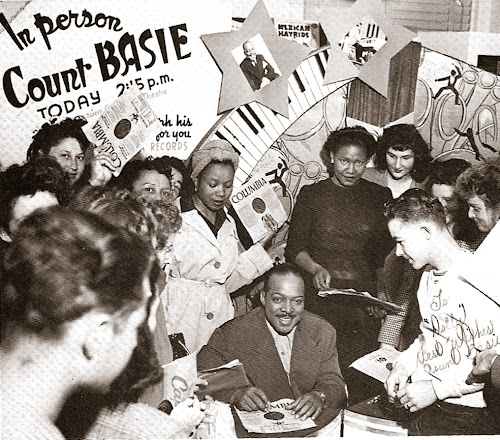
The Count creates a few souvenirs for fans at a mid-'40s "In Person" store appearance. Where or exactly when, let us know if you do. But it was no doubt close to the period represented by the offering below.

My first opportunity to see the great Count Basie came in 1972, when I was a college junior. The band came to Ithaca, NY, and played at a concert hall downtown that had opened to much fanfare a year earlier. I knew somebody working the door and got in for free. But I was deeply into the avant garde at the time and Basie was, well, old news. I hung around for fifteen minutes – long enough to say I'd seen the band – and then went off into the night to persue whatever it was that 20-something hippie children did in the night back then. Too bad, because that band was a killer group (as nearly all his bands were) with Eddie "Lockjaw" Davis back on tenor, Al Aarons on trumpet, Al Grey's trombone, and Eric Dixon and Charlie Fowlkes filling out the reed section.

My next chance to see the Kid from Redbank came eight years later at Chicago's massive annual jazz festival. A free event featuring a who's who of jazz stars over three days, the festival brought in the Count Basie Orchestra as the Saturday evening closer. This time I caught the whole show and loved it. The Count was ailing by then – he came on stage on one of those motorized chairs you see in grocery stores these days. But the band swung massively and rocked the huge crowd with the Loop's skyline in the background and a colossal, starry sky overhead. 

Four years later, Basie was gone and the jazz world had lost the man who had taught the world to swing. Needless to say, I was very grateful I had been able to see him at the helm of his extraordinary organization.

But now Basie's back. At least, he is here on Gems. We posted an offering of Basie-as-pianist a while ago, and decided to include this hard-to-find Count material as a complement. It's the orchestra from 1941, a period when the Count had lost his two star  tenors – Lester Young and Herschel Evans – and was running out his Columbia contract with the thought of moving over to RCA.  

Don Byas at a recording session in the mid-'40s.
From A Pictorial History of Jazz

Not there isn't plenty of star power here. Buddy Tate blows for Evans and the great Don Byas is in for Lester. Byas, who had scored a hit for Basie with his solo on "Harvard Blues," would go on from here to be a fixture on 52nd Street and the reed man in one of Dizzy Gillespie's first bebop combos. His duets with Slam Stewart at a 1945 Town Hall concert remain some of the most amazing performances in jazz history. On these sides, he gets ample solo space, and you can hear shades of things to come.

The tunes on this download aren't all that memorable, but the band plays them with verve and panasche. You get a real sense of the voluminous amount of material the Basie Band (and all the other swing groups) must have cycled through its book over the many years of its existence. Yet the guys continuously gave it their all, just as they do here. Inspirational!

This LP comes probably from some long-forgotten thrift store foray. It is one of three Basie reissues that came out in 1955 on Epic (the other two feature Lester Young). It's in excellent shape given its years, but Side 2 required a bit of cleaning up in places. I think you'll approve. The music in this download comes, as always, right from the original vinyl. 

Basie's Back in Town
Count Basie and His Orchestra
Epic LN 3169
Basie, p; Ed Lewis, Al Killian, Buck Clayton, Harry Edison, tp; Dicky Wells, Ed Cuffee, Dan Minor, tbn; Earl Warren, Tab Smith, as;  Buddy Tate, Don Byas, ts; Jack Washington, bar; Freddie Green, g; Walter Page, b; Jo Jones, d.
New York, NY; January 28, 1941

1. Jump the Blues Away 
2. The Jitters
3. Tuesday at Ten

Omit Jones; add Kenny Clarke, d.
New York, NY; May 21, 1941 

4. Down, Down, Down
5. Tune Town Shuffle

Omit Clarke, Wells, Minor; add Robert Scott, Eli Robinson, tbn; Jo Jones, d.
New York, NY; July 2, 1941

6. Basie Boogie
7. Diggin' for Dex

Omit Cuffee; add Dicky Wells, tbn.
New York, NY; September 24, 1941

8. Fiesta in Blue

Personnel as above, add Jimmy Mundy, arr.
New York, NY; October 1, 1941

9. Something New

Personnel as above.
New York, NY; November 3, 1941

10. Platterbrains

Omit Wells, Smith; add Ed Cuffee, tbn.
New York, NY; November 17, 1941

11. The Feather Merchant
12, Down for Double
Wednesday, July 24, 2013

West Coast Showcase

Two of LA's finest working out at a Pacific Jazz recording date. Art Pepper and Bud Shank also moonlighted for Decca in 1957, under the direction of composer Howard Lucraft. William Claxton photo

Here's a recording I came across in the stacks a few months back that I realized I'd never listened to (got quite a few like that!). I'd judged it by its cover when I acquired it a few decades back, thinking it was just another attempt by a major label to sell "jazz" to a mainstream audience with syrupy arrangements and restrained soloists. Wrong.

Lucraft with Lady Day during her
appearance on his "Jazz Inter-

national" TV show.
I'd never heard of Howard Lucraft, the album's arranger, composer and anonymous guitarist, before finding this LP. Despite my initial misgivings, he turns out to be a musician of some stature, and a very fine arranger/composer in the mainstream modern jazz vernacular. He also was an accomplished journalist, writing for jazz pubs like Down Beat and Metronome, a correspondent for the London Daily Herald and host of his own jazz radio and TV shows. He was also a very fine photographer, mostly of other jazz players.

A renaissance man, in other words.

Born in London during the first world war, Lucraft arrived in Los Angeles in 1950 and decided to stay. He worked in the studios, wrote, composed, arranged, broadcasted and even played out a bit. In '54 he hooked up with Stan Kenton and formed "Jazz International," an organization that promoted America's classical music worldwide. He even found time to make a few records.

This album didn't set the world on fire, but it's a fine, swinging affair with very tasty performances from the cream of the West Coast crop in 1957. Present are Bud Shank, Art Pepper, Conte Condoli, Bob Cooper, Buddy Collette, Pete Jolly, Red Mitchell, Stan Levey, Mel Lewis and others. It's almost as though Lucraft and Decca hijacked a Pacific Jazz session for this date. While the results are somewhat less adventurous than a typical PJ recording, the performances are excellent, and Pete Jolly's accordion is an added treat. The guitarist isn't really John Doe, by the way – it's Lucraft himself. Chalk up another skill for the multi-talented Brit.

This gem required no cleaning of sound, so what you hear is pure vinyl – taken directly from the original, of course.


Showcase for Modern Jazz
Howard Lucraft & Outstanding West Coast Jazz Men
Decca DL 8679

Collective personnel: Conte Condoli, Stu Williamson, tp; Bud Shank, Buddy Collette, Art Pepper, Charlie Mariano, Bob Cooper, reeds; Frank Rosolino, tbn; Pete Jolly, Claude Williamson, p; Howard Lucraft, g; Red Mitchell, Monty Budwig, Leroy Vinnegar, b; Mel Lewis, Stan Levey, Shelly Manne, d. (see cover for specific personnel)
Los Angeles, CA; 1957

1. Blue Moon
2. I'll Never Say Never Again
3. California Zephyr (Lucraft)
4. I may Be Wrong
5. Larrissa (Lucraft)
6. Midnight Sun
7. Smog a la Mode (Lucraft)
8. Jazz for Gene (Lucraft)
9. Two Part Contention

Find it here: https://www.mediafire.com/?4cak9a0mfc0bncn

Sunday, June 30, 2013

The Count at the World's Fair

God and Splank: Bill Basie and Art Tatum share a moment together at the keyboard. One no doubt serving up a cascade of notes while the other contemplates the ivories. From the collection of Catherine Basie

Sometimes you come across the most amazing things in the most out-of-the-way places. A cliche, yes, but true enough. Here's yet another affirmation of it's shopworn validity.

Melby's Market, the general store at the crossroads in
North Waterford. Bison burgers are the house specialty.
A few weeks ago I was up in Maine on my semi-annual sojourn to visit my folks. We're inveterate yard-salers, and we spent a Saturday morning trolling about, looking for treasure. We eventually wound up in Waterford, searching for a flea market that supposedly was being held on the North Waterford World's Fair fairgrounds. Waterford is a lovely little New England town, perfect for a Saturday Evening Post cover, but North Waterford is little more than a sandy crossroads a short ride from its larger namesake. 

At North Waterford's crossroads, we decided to go left. There were no signs, and no indication of anything like a fairgrounds. But then, half-a-mile up the road, there was a hand-painted, weather-beaten board proclaiming "Fair Parking" with an arrow pointing left up a dirt road that skirted around what appeared to be a dilapidated, abandoned chicken coop. Never shy about dirt roads, my parents veered up the hill, bouncing the car over ruts and stones and on into the woods. 

The World's Fair's logo
The road ran upwards through the trees and overgrown blueberry bushes, around several more tumbling-down structures, before emerging a quarter-mile later onto a weedy field surrounded by more shanty-like sheds. "Welcome to the North Waterford World's Fair" a faded banner proclaimed. Apparently we had arrived at the fairgrounds.

True to the claim in the classified ad in the paper, there was a flea market going on. A dozen sellers had set up tables in a few of the sheds, their wares piled on overturned cardboard boxes or arrayed on folding tables. It was a pretty meager showing, but we'd come that far, so we climbed out of the car. Romance novels, kiddie clothes, VCRs, kitchen gadgets, crocheted novelties, rusty tools – the usual stuff, being picked over by a few buyers. But then something caught my eye. 

An artifact from the jazz world of December 1936 –
Down Beat was still a monthly then.
On one end of a table there was a pile of sports and hunting magazines. Sticking out from near the bottom of the heap was what looked like – could it be? – an ancient Down Beat. And so it was! A DB from way back in 1936, two years after the venerable jazz rag had published its first issue. I feverishly leafed through the rest of the magazines, but there were no others. I was immediately struck: How had a 77-year-old newspaper made it all the way to ... North Waterford? 

One of life's great (or not so great) mysteries.

The paper was in great shape with no tears and no pages missing. I paid a buck for it and spent the better part of an hour going through it back at my folk's place. Here were stories that mentioned Earl Hine's orchestra at the Grand Terrace in Chicago, a blurb about young trumpet upstart Roy Eldridge tearing it up over nightly network broadcasts, and a feature about Mildred Bailey and her new hubby, Red Norvo. Plus loads of great period advertisements, record reviews and nightclub listings. One thing that struck me: So many of the musicians mentioned I'd never heard of before. Shown on the mag's cover were Margie Lindt, Bob "Bazooka" Burns, Frankie Masters, Romo Vincent, Charlie Trotta, John O'Donell and many others. Who? I don't know, and history doesn't either.

But there was one fellow – a pianist – whom history hasn't forgotten. And the squib in Down Beat that mentions him is perhaps one of his first national press clippings. It's 32-year-old Bill Basie, nicknamed "Count," and it prominently features what the magazine claims is the first photo to be published of the band leader. Basie and the boys had been getting their road show together, playing at the Grand Terrace for an extended stay before heading to New York to record for Jack Kapp and the Decca label. John Hammond, who had discovered them when he chanced to hear a radio hookup from a Kansas City nightery, had tried to get them signed to Columbia. But Kapp had beaten him to the punch. So Hammond famously arranged to secretly record Basie in a small group (with Lester Young) while the band was in Chicago. Those sides were issued as by "Jones-Smith Incorporated," and they remain classics. 

Though it took place just a few months earlier, there's no mention of that recording session in the article. But the orchestra gets a glowing review and Basie and his rhythm are rightly credited with being the finest in the nation. So I thought it only appropriate that Gems serve up a few examples of the Count at the piano to celebrate this bit of jazz history that serendipitously came my way in far-flung North Waterford, Maine.

This is a French release, consisting of rare airchecks and TV broadcasts – one of vast series of intriguing records that were issued by Musidisc in the 1970s. They're pretty common, but this one seems harder to find than others. The music here is extraordinary, with Basie providing what amounts to a primer on blues piano. There are also great solos by bassist Eddie Jones and even a "solo" from guitarist Freddie Green (on "Cute"). Wardell Gray is present, too, on one selection. "Nails" is a remarkable display of wry humor and subtle ensemble playing, not to be missed. The sound varies – tape hum being the worst of the defects – but the music, as always, is "keel-ling." And next time you're in the Lakes Region in Maine, check out the North Waterford World's Fair. You never know what you'll find ...

These files were ripped from the original vinyl with, in this case, no cleaning of the sound whatsoever.


The Soloist
Count Basie
Musidisc 30 JA 5204

Count Basie, p; various groups including Walter Page, Freddie Green, Jo Jones; Wardell Gray, Clark Terry, Marshall Royal; Eddie Jones, Sonny Payne; and others (see download for full personnel, dates).
Airchecks, TV broadcasts; New York, Paris, Zurich, San Francisco; Various dates, 1941-1967

1. There'll Be Some Changes Made
2. Rockin' Chair
3. Basie Boogie
4. Basie Boogie
5. Basie Boogie
6. Basie Blues
7. All of Me
8. Cute
9. Blues No. 2
10. Squeeze Me 
11. Blues No. 1
12. Blues No. 3
13. As Long As I Live
14. Blues No. 4
15. Nails

Find it here: https://www.mediafire.com/?dxjy4lzlk4p3cc8

Wednesday, June 26, 2013

Butch Morris Time

Talk about deep: Twenty-year-old Doug Morris, a U.S. Army medic serving in Germany in 1967, studies up on applied harmony. Fifteen years later, Butch Morris would begin to reshape the sound of the jazz avant garde. Photo courtesy of Don Heffington

This post has been a long time coming, but I've finally found the time to tackle it. If you've followed Gems for a while, you'll recall we did a piece a while back on A.R. Penck that featured Butch Morris. Well, not long after that posting came the distressing news that Butch had passed away.

He'd been ill for a while, something I was unaware of (news travels slow here in the foothills of the Catskills). So it came as a shock to learn that he was gone. It seems like only yesterday he was working on his music box project and leading conductions with many musicians I know, some quite well. 

Butch had perhaps the purest sound on his instrument since ... well, since Bobby Hackett. An odd pairing, but not many contemporary horn players are cornetists, and Butch was a superb player, very much like Hackett had been decades earlier. Butch was also a master of effects on his instrument. Bubber Miley would have been impressed by his growls and feints and squawks. Mr. Morris was no stranger to the Ellington jungle.

With this entry, Gems offers its visitors two Butch Morris treasures. One is an excerpt from a conduction that Butch did in 1985 during an epic art performance piece based on the works of the Spanish painter Goya. The other is a wonderful collection of photographs from the days when Butch was known by his middle name, Douglas – days long before he was acknowledged on the downtown scene and around the world as a major innovator in the field of creative music. 

So consider this Gems' tribute to one of the great creators of late 20th and early 21st century jazz. Lawrence Douglas "Butch" Morris will be much missed. We shall not see another like him ...

When Butch was Doug

These photos come to us from Don Heffington, a gentleman whom I met over the Interwebs through a mutual friend. As a teenager, Don was in one of Butch's early bands in Los Angeles. He has graciously given permission for Gems to post these photos, all of which I believe have never been seen publicly before. Don also gave the eulogy at Butch's funeral and we've included that here as well. It tells the story of his long friendship with Butch and is a lovely tribute. Many thanks, Don!

The Doug Morris/Sam Johnson Band, above and below, in 1965. Sam Johnson on
bass, Clarence Peace on alto, pianist Andre, Doug Morris on trumpet and Don
Heffington, right, on drums. Los Angeles, 1965.


Doug Morris in the army in 1967 – Fort Ord, above, and in Germany, below.


The Doug Morris Quintet at the Palladium in 1966. Doug Morris, left, and Don
Heffington, right. Photos courtesy of Don Heffington

Going, Going, Goya

"Goya Time 1985 New York" was a grand-scale performance in the style of the "happenings" that were common art community activities in the early '60s. It was conceived and organized by one Dr. Sandro Dernini, a gent described as "an accomplished biologist from the island of Sardinia." "Goya Time" featured a script by Dernini, choreography by Gretta Safarty and music by Butch Morris. The whole affair took place in a Lower East Side building known as "Cuando," a cavernous place that had been a school at one time. By 1985 it had become a space for music concerts and art exhibits. It was gray and dreary on the inside, run down and in need of repair – in short, just the sort of venue perfect for presenting Goya's era of faded decadence and lethal intrigue.

I wasn't at the actual performance – it went on for many hours and there's just so much high art I can tolerate before I need to find an exit. But I was at part of the dress rehearsal. It was a much shorter affair, but just as chaotic, noisy and colorful as the main event. Declaiming actors wandered in and out of the gymnasium where Butch's musicians were creating a soundscape of melody, poly-rhythms and spiky cacophony. Dancers flitted by, appearing in the doorways one moment, on balconies the next. Interpretations of Goya's paintings hung on the walls and – if I remember correctly – an artist was on stage painting on a huge canvas and on a naked woman's body.

It was one whacky scene, and in the midst of it all was Butch and his musicians. The download included here is only a very small portion of the entire performance. But it captures the feel of the event and gives you an idea of how Butch could alter the music through his conduction technique to accommodate whatever was happening around him. One of the vocalists, by the way, is the extraordinary Shelly Hirsch. If you're unfamiliar with her work, Google her. She's amazing.

Butch Morris conducts "Los Capricios" during "Goya Time 1985 New York," a massive
performance piece that took place on June 13, 1985, on Manhattan's Lower East Side.
Photo from plexusinternational.org 

Goya Time 1985 New York
Butch Morris Ensemble
Cuando, Lower East Side, New York, NY; June 13, 1985
Butch Morris, comp, cond; JA Deane, el tbn, synth; Jason Hwang, vi; Marion Brandis, fl, alto fl, small inst; Myra Melford(?), p; Shelly Hirsch, unknown, v; others unknown.


1. Los Capricios, Part 1


Find it here: https://www.mediafire.com/?d5vuv0vuzd6d0br