Sunday, January 27, 2013

Fixing Broken Links

So many sides, so little time! Especially when Gems has to repair links to music already uploaded ... 

Well, a few of the tens of visitors here to Gems have let us know recently that a good number of the downloads offered here suffer from broken links. The curse of the blogger! Suffice it to say that all (or nearly all) have been reuploaded, this time to the dreaded (not so dreaded anymore) Rapidshare. So if you've been interested in Hazel Scott, West Coast Jazz, the Jazztone sampler, KC or Chicago jazz, jukebox tenors, the other JATPs, the Norman Granz two-fer, Benny Goodman or any of the other postings that have gone dark, they should now happily be functioning. Until the next time that is, so git 'em while they're hot.

This just in: Thanks to jazzcat, the blocked files should now be available. Give one or two a try and let me know if there's still a problem. Sorry for all the fuss!

Sunday, January 20, 2013

A Visit to Jazzville

The "Springfield Rifles," i.e., the guys who played jazz from Springfield, Mass., circa 1946. From left are Hal Serra, Chuck Andrus, Joe Morello, Phil Woods and Sal Salvador. Photo from local802afm.org

If you tootle around eBay like I do occasionally (well, more than occasionally), and you look for jazz LPs, you've probably seen the record below offered for big money. Why? In a word, cheesecake. Collectors of genteel erotica pony up real dough for albums with over-exposed attractive young women on them. The cover of this Dawn LP is particularly sought after for that reason.

Music? Who cares about the music?

Well, I do (he said self-righteously). And so do you. So that's why I'm posting this album – because it's hard to find, and the music on it is excellent. Not that the comely Vespa jockey isn't an added attraction. But rare sides by Gene Roland and the ultra-obscure Hal Serra are the main reason we (meaning me) here at Gems do what we do.

A funny story about this record. I found it years ago at a church white elephant sale in Connecticut (when I was briefly living there) and listened to it a few times before sticking it in the stacks and forgetting it. Zoom ahead a dozen years to the mid-'90s, and I'm doing my radio show at our newly launched NPR-affiliate, WJFF. I'd pulled "Jazzville, Vol. 4" as part of the afternoon's offerings, and was getting set up for the show when I noticed the name "Dudley Watson" in the album's liner notes. Dudley was the bass player on several of the Gene Roland pieces on the record.

The remarkable Dudley Watson,
performing on WJFF's "Live from

Studio B" in the winter of 1994.
Photo by Able Rae
Dudley Watson was also the bass player on the live, in-studio jazz performance show that followed mine that afternoon.

Yeah, that's right. For about 10 years, I also co-hosted a live-jazz program called "Live from Studio B" on WJFF immediately after my record show. Every week we'd have a different group of local jazz players come by and play for an hour. That week's group included Dudley on bass. Talk about serendipity.

Dudley was an extraordinary character. A true jazz gentleman, he was from the old school, a hipster from the days of Bird and Diz. He'd been playing bass for some 50 years when I knew him, and he'd never missed a beat. He was always attired in a sport coat and tie, and invariably wore a short-brimmed fedora. Being an albino, he had to be careful of the sun and had weak eyes made huge by exceedingly thick glasses. Even so, he managed to get around with the agility of a man half his age – all the while lugging his big double bass.

So ... on the day I brought "Jazzville, Vol. 4" in to play on my show, we had Dudley Watson both on wax and live in the studio. A real treat!

These Roland tunes and those by Hal Serra are also a real treat. Serra was originally from Massachusetts' capitol city, though he'd been a New Yorker for many years. His credits include stints arranging with June Christy and Ella Fitzgerald, but he remains largely unknown to most listeners today. He unfortunately passed away about six months ago but, as you'll hear on this download, he's a fine pianist and someone well worth seeking out.

The same can be said of Gene Roland, though his music has always been a bit more in the public eye. These arrangements are real swingers, as are the tunes. It's interesting to hear Paul Quinichette outside of the usual Basie-esque setting, too.

A word about the sound quality. I have a dozen vintage Dawn LPs and, though each looks absolutely pristine to the eye, each invariably plays with a fair degree of surface noise. No degree of washing seems to help (as it often does with most noisy LPs). So be forewarned – there is a good deal of hiss in places on this record, especially in the last few Serra numbers. No pops or clicks, just "sssssss." The music, though, is well worth hearing despite the somewhat defective sound.


Jazzville, Vol. 4
Gene Roland/Hal Serra
Dawn DLP 1122

Gene Roland, comp, arr, tp; Johnny Carisi, tp; Dick Meldonian, as; Paul Quinichette, ts; Robbie Swope, tbn; Nat Pierce, p; Dudley Watson, b; Walter Nolan, d. 
August 20, 1959, New York, NY.

1. Suitcase
2. Minor Scene

Gene Roland, comp, arr, tp; Paul Quinichette, ts; Nat Pierce, p; Freddie Green, g; Wendall Marshall, b; Sonny Payne, d. 
August 26, 1957, New York, NY.

3. Colonel Hodge

Gene Roland, arr, tp; Paul Quinichette, ts; Nat Pierce, p; Doyle Salathiel, g; Oscar Pettiford, b; Osie Johnson, d. 
August 13, 1957, New York, NY.

4. The Creeper (Pettiford)

Hal Serra, p; Bert Collins, tp (2, 4); Ernie Furtado, b (5, 9); Earl May, b (6, 8); Joe Williams, b (7); John Cresci, d (5, 7, 9); Ed Thigpen, d (6, 8)
1958, New York, NY. 

5. Everything I've Got Belongs to You
6. Why Was I Born
7. Irma (Serra)
8. Suddenly It's Spring
9. The Things I Love

Find it here: http://www.mediafire.com/?oocbdqozx1e1i4w

Thursday, December 20, 2012

Holidays in Swing Time

Season's Greetings from Hamp and the guys, and also from the crew here at Gems! This full-page ad appeared in the December 31, 1947 edition of the venerable Down Beat magazine (then more of a newspaper). Note the "new creation in a new movement" – "Mingus Fingers." Bebop at its greatest, indeed!

It's that time of year again. This is Gems' second holiday season, and we just want to thank all the many jazz fans who've visited this site and have shared their insight and enthusiasm with us. It's been great fun digging through the collection, uncovering interesting recordings and posting them here. And we promise more to come in upcoming months.

Meanwhile, here's a holiday treat for one and all. It's a jazz version of the old TV fireplace filled with cheerily burning yule logs. The soundtrack, of course, is by some of jazz's great players. So click the full-screen control, hit the start thingie and – viola! – bright and warm holidays in syncopation!

The music starts with Hamp and goes on from there. All of it is readily available, so there's no download this time (though I suspect you can figure out how to get it anyway). Enjoy, and happy holidays from us here at Gems to you and yours!


Holidays in Swing Time  
A Seasonal Mix 
1. Boogie Woogie Santa | Lionel Hampton and his Orchestra, vocal by Sonny Parker
2. Greensleeves  |  John Coltrane  
3. Sleigh Ride  |  Duke Pearson Trio
4. God Rest Ye Merry Gentlemen  |  Jimmy Smith, Oliver Nelson arrangement 

Monday, November 26, 2012

Hines' Varieties

On the ball: The Fatha takes a break from the keys to roll a few at the lanes. Very
nice form, don't you agree? This was taken about the time these recordings were
made. From "The World of Earl Hines"

Here's another Earl Hines offering – one that's a bit more contemporary than those of our previous postings. Hines has long been one of my favorite players, ever since I first heard his keyboard gymnastics on "Weather Bird" with Louis. His sense of rhythm was far more advance than any of his contemporaries, with the possible exception of James P. He just knocked me out!

I was filing away some records I'd pulled for my radio show when I came across this gem. It's another of those cheapo budget records from the early '60s, but it's not one that you see very often and the music reissued on it comes from an interesting period in Hines' career. Plus, these sides were all originally recorded for the short-lived Sunrise label in Chicago, making them pretty rare (back before the Internet, that is).

There's another reason why I decided to upload these files. The record has an interesting story behind it (are you surprised?). 

When I was living in Hyde Park on the south side of Chicago, I spent a lot of time in used record stores and thrift shops. There were great records to be found there as you might imagine, and I found quite a few. One day I purchased an LP with curious notes on its backside written in blue ballpoint pen ink. The notes added information on personnel, and on session dates and locations. They also commented on the various tunes on the LP – things like "Dynamite Blowing – a Real KICK!!!" and "Slow Burner – Tpt. Solo – Bold!!!" Whoever had made the notes used exclamation points freely.

A sample of the mysterious annotations, made
on a Duke Ellington record. The writer put much
effort into drawing lines and curious symbols.
I didn't think much of it until I came across another LP with similar jottings. And then another, and another. I began seeing dozens of records with the ballpoint marginalia in many of my record haunts. I decided that somebody was getting rid of a collection of primo jazz sides piece by piece, selling LPs to dealers as circumstances dictated. The variety of detailed information and the evaluations of the tunes (the writer had an elaborate system of stars and crosses for rating them) made me suspect that the original owner may have been a radio DJ. The notes served as a guide for picking material for his show on the fly – he wouldn't have to preview the music, just grab and go. 

I never found out the true story behind the ballpoint annotator, but I did end up with about thirty of his records. This Hines LP is one of them. The interesting thing about his notes is that he not only knows the correct date and place for Hines' Sunrise sessions, but he knows many of the players as well (more than are listed in my discography). The record itself offers no info whatsoever on the material. My question is this: How did this fellow know these things? Did he have the original Sunrise releases? Did he know one of the sidemen, or possibly Hines himself? Was he a serious hipster on the scene? This last hypothesis seems to be borne out in his liberal use of jive argot – as in "T-pipe" for "tenor saxophone."

Johnny Hartman
Whatever the case, we have here some rare Hines recordings that capture the Fatha in a period of transition. His big band had just been disbanded, a victim of changing tastes and shrinking budgets, and he'd just been hired by his former recording partner, Louis Armstrong, to be a sideman in Satchmo's first All-Stars unit. It must have been a difficult time for Earl. Victor was no longer recording him, so he went with Sunrise and issued a series of tunes in a variety of styles. In this download you'll hear the first gleanings of R&B, sweet ballads with strings and some straight-ahead jazz in the tradition. It's like Hines was hoping something would catch the public's ear but wasn't sure quite what.

The Dark Angel of the violin –
Eddie South
That said, you get to hear the immortal violinist Eddie South on three of these titles (and maybe more if, like me, you suspect it's Eddie South and not Bill Dougherty playing fiddle on some of the other tunes). You'll also hear the first recordings of a young up-and-coming baritone named Johnny Hartman, as fluid and smooth as he'd ever be even at age 24. Then there are the fine arrangements of Ernie Wilkins (or is it Budd Johnson?) on the big band sides. The jump tunes with Wini Brown feature a band pulled from Lionel Hampton's orchestra – with Mingus on bass! "Blues for Garroway," by the way, refers to Dave Garroway, then a nationally known Chicago radio personality and promoter of jazz. Earl no doubt was hoping Garroway would use the tune for his theme.

After 1947, Earl Hines would never again front an orchestra of his own on a permanent basis. Too bad, but then we wouldn't have his many decades of stellar trio and quartet work. So enjoy this last gasp of one Hines tradition. And see if the mysterious annotator doesn't inspire you to form your own theories about his story.

As always, these files were ripped from the original vinyl with just a mild cleaning of light pops and clicks.


Earl Hines and His Orchestra
Earl Hines
Hines, p; Morris Lane, ts; Eddie South, vi; Bob Wyatt, org; Ernest Ashley, g; unk. b, d.
Chicago, IL; December 1947

 
1. Honeysuckle Rose
2. Dark Eyes
3. Blues for Garroway

 
Hines, p; Duke Garette, tp; Bobby Plater, as; Morris Lane, ts; Charlie Fowlkes, bar; Bill Dougherty, vi; Bill Mackel, g; Charles Mingus, b; Curley Hamner, d; Wini Brown, unk., v.
Chicago, IL; December 1947

 
4. The Sheik of Araby
5. No Good Woman Blues

 
Hines, p; prob. Willie Cook, Vernon Smith, Fats Palmer, Charlie Anderson, tp; Bennie Green, Walter Harris, Gordon Alston, tbn; Clifton Small, tbn, p; Scoops Carey, Thomas Crump, as; Ernie Wilkins, Budd Johnson, ts; Wallace Brodis, bar; Bob Wyatt, org; unk., vbs; Skeeter Betts or Bill Mackel, g; Calvin Ponders, b; Gus Johnson, d; Johnny Hartman, Melrose Colbert, v; unk. string section.
Chicago, IL; late 1947

 
6. Ain’t Misbehavin’

 
Personnel as 4, 5:
7. Bow-legged Mama

 
Personnel as 6:
8. Black and Blue
9. I Need a Shoulder to Cry On

 
Personnel as 4, 5:
10. My Name Is on the Doorbell


Find it here: https://www.mediafire.com/?emw51rme3yyr1n2

Friday, November 9, 2012

Wailin' with Hamp

Lionel Hampton runs through a few two-fingered piano riffs prior to a show in the late '50s.
Photo from "Hamp," his autobiography

Barry O snags a
second shot.
The re-election of President Barack Obama reminds me of a time when I was directly involved in presidential politics, and that spurs me to offer this recording by the great Lionel Hampton. The connection may be a stretch, but I'll go with it since it's nice to have a logic (however contrived) behind these musings here on Gems.

In 1970, I worked for the late Senator George McGovern's presidential campaign, going door to door in the Syracuse, NY, region in an effort to get out the vote. Like many college kids from that era, I was firmly against the war in Viet Nam and believed that George would end it once elected. My canvassing partner and I were assigned to one of the poorer neighborhoods and the work was anything but easy. People answered our knocks – when they answered at all – with half-opened doors and suspicious looks. Nobody wanted to hear us talk about the Senator from South Dakota; they just wanted to get the two white kids from somewhere else off their front porch. 

Lionel Hampton chats with Richard M. during a visit to
the White House in 1970.
The experience impressed upon me just how complex the American political landscape can be. Another example could be found in Lionel Hampton's very public support for former Vice President Richard Nixon, McGovern's opponent. Back then I was just beginning to explore this music called jazz, and the idea that someone of Hamp's stature could support a war-mongering honky square like Tricky Dick just defied all logic. Of course, my eighteen-year-old political reasoning was anything but nuanced. But I really had trouble getting my head around the fact that a jazz giant was embracing a guy who seemed to be against everything that jazz stood for.

Of course, McGovern went down in one of the worst defeats anyone in a presidential election has ever experienced. Nixon went on to run afoul of the Watergate caper and also came up a loser. Our bumper stickers in Boston read, "Don't blame me – I'm from Massachusetts." 

But Lionel Hampton went on to play music for another three decades, swinging just as hard as he ever did. He was clearly a survivor, and that spoke volumes about his decision to go with the Repubs. That and the fact that his politics were pretty conservative to start with.

There's nothing political about this posting. It's just Hamp and the guys blowing for a rowdy crowd at a dance at Chicago's famed Trianon Ballroom. This is how live-in-concert recordings should sound – the crowd is vociferous, hip and paying attention. And Hamp and his men rise to the occasion. No great soloists here – Jay Peters and Jay Dennison are featured, and neither is exceptional. But they have a grand time and, if you can overlook Dennison's repetitious "Casbah stuff," you will too. And Hamp's solo turn on "Stardust" is worth the download all by itself.

As always, these tunes were ripped from the original vinyl, in this case a mono veteran of many years of repeated playings. There was a lot of surface noise that had to be cleaned up, so you may notice some minor digital artifacts here and there. But play it loud, roll back the rugs and pretend you too are at the Trianon ...


Wailin’ at the Trianon
Lionel Hampton and his Orchestra

Hampton, vbs; Billy Brooks, Wallace Davenport, Ed Mullens, Roy Slaughter, tp; George Cooper, Al Hayse, Harold Roberts, tbn; Jay Dennison, as; Bobbie Plater, fl, as; Edwin Frazier, Jay Peters, ts; Oscar Estell, bar; Dwike Mitchell, p; Billy Mackel, g; Peter Badie, b; Bill Eddleton, d.
Trianon Ballroom, Chicago, IL; July 22, 1954; Columbia CL1711

1. The Chase  12:05
2. Stardust  6:34
3. Mark VII  5:28
4. How High the Moon  8:58
5. Love for Sale  5:39
6. Wailin’ at the Trianon  6:17


Sunday, October 28, 2012

Great Black Music

I was fortunate enough to attend the first night of this 1977 concert series. Braxton's
collaborative group with Jenkins and Smith was stellar
. They had recorded for Delmark
a decade earlier. Music, as the AACM would later say, stronger than itself!

I have a truckload of jazz ephemera from my days living in Chicago and New York, and I've been thinking I should post some of it here on Gems. Even though this is supposed to be a blog that shares rare and unusual recordings with its visitors, every now and then I can't resist posting some visual stuff. So here is a selection of posters and flyers from some noteworthy but mostly undocumented jazz performances. I thought for this first installment I'd concentrate on Chicago and shows by members of the revolutionary Association for the Advancement of Creative Musicians.

Many of these concerts I attended, and all of them are a testament to the dedication of some great players who were in the music solely to advance tradition, art and culture. By the time I was in Chicago, the first-string AACMers had mostly decamped to New York. But there remained some very fine players, some of whom are represented here. To wit:

This Joseph Jarman performance comes from 1975. A show done
a year later at the University of Chicago was the first jazz concert
I saw after moving to the city. That solo show
was later released 
on the Art Ensembles' own label, AECO.
This performance by multi-reed player and flute maker
Douglas Ewart took place in 1977. The concerts below, featuring

Ewart's adventurous clarinet choir, were also held that year.
I missed this one, unfortunately. George Lewis was (is)
an amazing trombonist, electronics wizard, philosopher,
theoretician and – now – author and historian. He and

Douglas Ewart worked together quite often in the late
'70s. This show is from 1977.
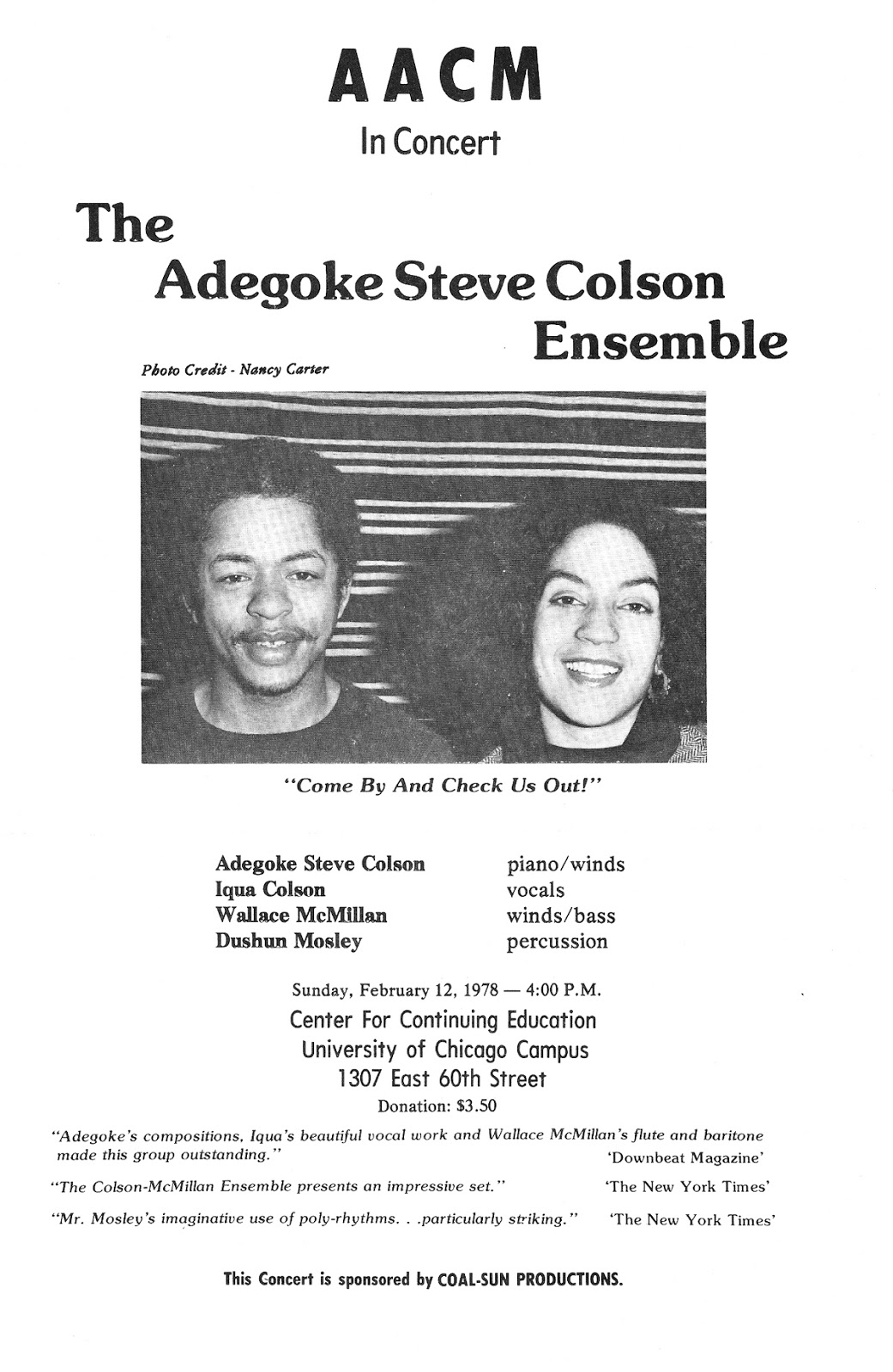
Here's Chicago's first couple of creative music. Later the 
Colsons made occasional appearances in New York, and
eventually moved there in the '80s.
I saw this solo concert. Lester divided the performance into
two sets – the first consisted of free-from improvisation and
the second a reinterpretation of a number of jazz classics.
His rendition of Miles' "Walkin'" – replete with walking – 
was hilarious!
Ken Cheney is one of the less well known AACM members,
but
he's been a fixture on the Chicago scene since the '60s.
He
works most often with reed player Mwata Bowden.
This series was from 1977. Ed Wilkerson was one of the
younger AACM members at the time and was just
beginning to display his talents as a composer and
arranger. He often partnered with Light Henry Huff.
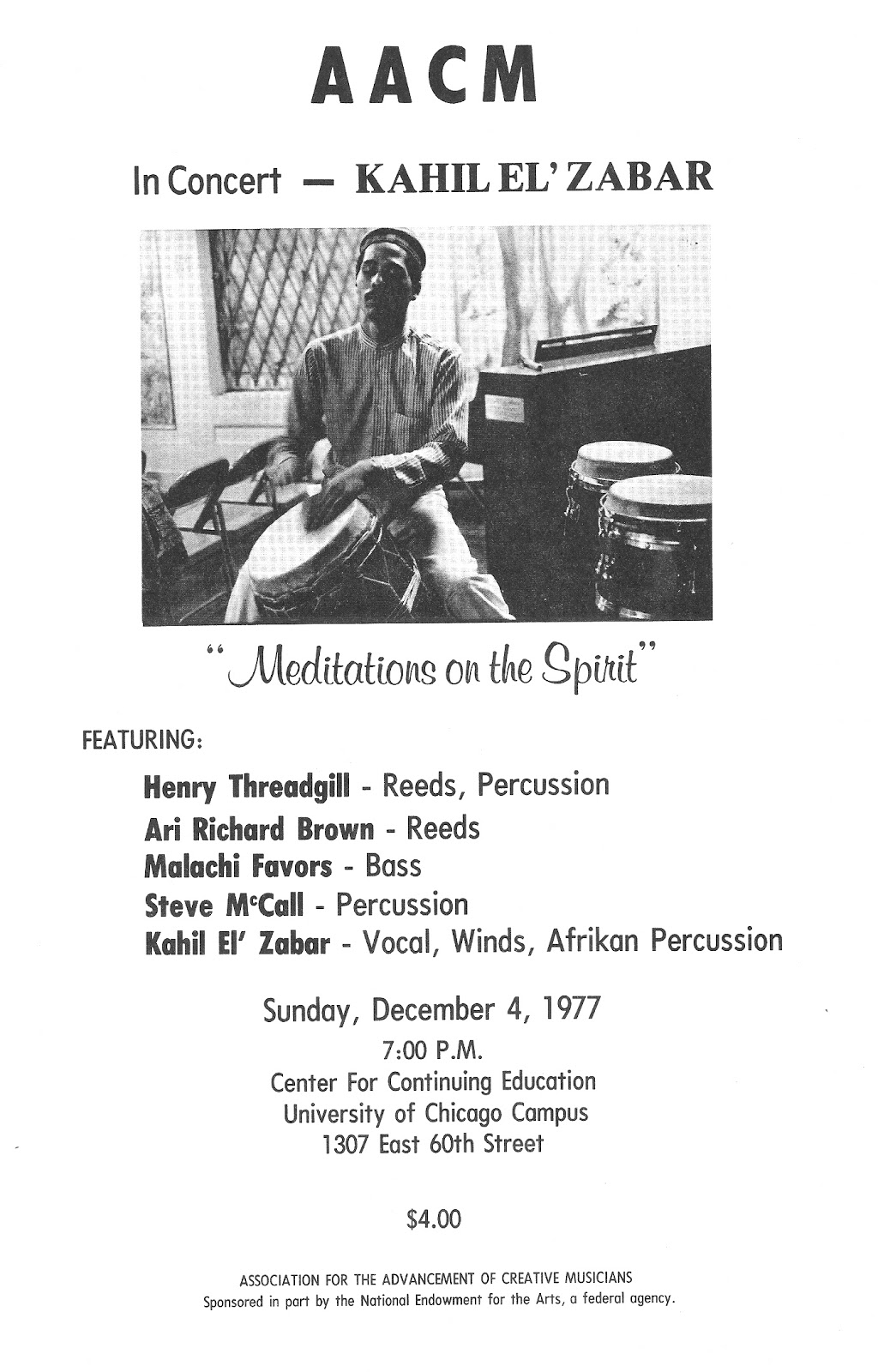
Kahil el-Zabar was the AACM's chief percussionist – and I
don't believe I ever saw him play a trap set. This concert
was a one-time event, and the group was a superb one.
Ari Brown went to work with Art Blakey's Jazz Messengers
not long after this performance.
The Underground Festival was organized as a counterpart
to the recently created Chicago Jazz Festival. The bands
featured were all from the creative music community,
mostly AACM groups, and the shows were very successful.
I saw Threadgill's legendary Sextet(t) and they were even
better than they were on record.
Here's one of Ed Wilkerson's early bands, Shadow Vignettes.
He later put together Eight Bold Souls, featuring many of
the AACM's younger members. I always loved Ed's approach
as he brought a welcome bit of levity to the often overly
serious attitude surrounding the new music. These shows
were from 1981.
Back in the 1970s, many AACM concerts took place at the
University of Chicago. The university's radio station had a
number of knowledgeable DJs who were fans of the new
music, and they often promoted shows like this one by AEC
drummer Don Moye and Von Freeman's son, Chico.

That's just a sampling of some of the music that could be heard in Chicago in the late '70s and early '80s. Audiences for creative music were small but enthusiastic, and there were a number of sympathetic journalists who respectfully reported on AACM doings for the Chicago Reader, Down Beat and even the straight dailies. While I was a student at the U. of C., I attended as many shows as I could and experienced many memorable moments. 

Occasionally a recording of one or another of these concerts would come my way, and I thought since this is indeed a music blog, I'd share an excerpt from one of them. It's from another University of Chicago show, done on February 11, 1977, and features Don Moye's Malinke Trio. The late reed player and composer, Julius Hemphill, is the trio's prominent soloist for the opening part of the performance. Next comes a bass-and-drum duet demonstrating Favors' big sound. Then it's Moye who takes over with an extraordinary display of his precussion skills on conga. I doubt this group existed beyond this one performance, but the cohesion exhibited is a testament to the musical prowess of the players. Don Moye later had a drum ensemble called Malinke, but this trio may be one of the first examples of a Famoudou group with that name.

A caveat: The recording quality of this aged dub is not the best. I've doctored it a bit, but there's still some wow-and-flutter, background noise and other audio flaws. The music, as always, is amazing so I hope you'll pardon any sonic imperfections.


Malinke Trio
Don Moye
Julius Hemphill, sopranino, as, fl; Malachi Favors, b; Don Moye, d, conga, perc.
University of Chicago, Chicago, IL; February 11, 1977

1. Alto solo #1, trio
2. Bass and drum duet
3. Alto solo#2, trio
4. Alto and drums duet
5. Sopranino and conga duet

Find it here: http://www.mediafire.com/?x84zhf2v5qoab3o
Monday, October 8, 2012

Goin' to Kansas City

The unfortunately ill-treated inside cover to Decca's classic "Kansas City Jazz" album. Basie's
been obliterated, but there's a candid of the legendary guitarist Floyd Smith, and one of Joe
Keys from the Blue Devils and another of the unjustly obscure Clarence Trice. Most of these
shots must have been taken during Decca's marathon November 1940 recording sessions
with the guys from Kay-Cee.

It's my firm belief that the familiar swing of jazz – as we understand it today – came to us from the Tom Pendergast's Kansas City of the 1930s. Specifically, from the men and women who created an original sound in the city's many night clubs, dance halls, speakeasies and dives. Four beats to the measure never swung so hard.

Here's impresario Gene Norman with a couple
of wannabe starlets, digging the sounds of
our offering for this posting. A typical period
pose
from the editors at Down Beat magazine.

If you're not convinced, I offer this posting as as Exhibit A. It's from Decca Records' 1957 series of regional reissues (the "Chicago Jazz" LP posted a while back is another) and it features a veritable who's who of KC players. Most of these recordings were originally done in New York over a seven day period in 1940, so they come from a time when the heyday of Kansas City jazz had largely passed. But present are many of the original Blue Devils plus pianists Pete Johnson and Mary Lou Williams. The real treat is the two sides from Basie's superb composer and arranger, trombonist and guitar man Eddie Durham.

You hardcore collectors certainly know that all these tunes are available elsewhere – especially the familiar Basie numbers. But having them all in one place is a treat. You get a real feel for KC's hotbed musical environment. The two titles by Mary Lou are fairly obscure and feature terrific work from Shorty Baker (pre-Ellington, of course) and driving solos from long-forgotten Andy Kirk tenor star, Dick Wilson. Ms. Williams herself is in full command of the keyboard and her arrangement of "12th Street" occasionally foreshadows the developments of bop several years hence.


Gems' copy of the original release
is a little worse for wear. We
opted
to use the LP version for the upload.
Then there's Eddie Barefield's unattributed clarinet on "South" with Lips Page's pick-up band. That coupled with the leader's muted trumpet solo and Don Byas' still-developing tenor sound make the tune a classic. Pete Johnson's band rollicks through a tune named for the Kansas City Colored Musician's Union, Local No. 627, with the cast the same as for Lips' titles. Great Don Stovall here. Roll 'em, Pete!

The standout for this posting has to be the rare Durham sides. Not only do we get Eddie's advanced electric guitar work, but Buster Smith demonstrates why Bird's sound was compared to his in Parker's early days. And catch the soli toward the end of "Little Girl" – fabulous Durham writing and very tight playing by the guys. 

Note that the liner notes for this LP refer to its selections as "dance compositions." Exactly right. This was music to move your feet to, and if you're like me your toes will be tapping. This is the music that taught the rest of the jazz world to swing. Mixed in, of course, were some of the greatest jazz statements by some of the music's greatest practitioners. You only have to catch the bookended solos by Hershel Evans and Prez on "Doggin' Around" to understand that.

So, download and roll back the rugs! As always, these tunes were ripped from the original vinyl with, in this case, no cleaning of the sound.  


Kansas City Jazz
Various Groups
Personnel listed in download
Decca DL 8044

Pete Johnson's Band
November 11, 1940
1. 627 Stomp
Joe Turner and His Fly Cats
November 11, 1940 
2. Piney Brown Blues
Mary Lou Williams and Her Kansas City Seven
November 18, 1940 
3. Baby Dear
4. Harmony Blues
Andy Kirk and His Clouds of Joy
November 7, 1940 
5. The Count
6. Twelfth Street Rag
Hot Lips Page and His Band
November 11, 1940 
7. South 
8. Lafayette 
Count Basie and His Orchestra
August 9, 1937 
9. Good Morning Blues
10. Doggin' Around 
Eddie Durham and His Band
November 11, 1940 
11. Moten's Swing
12. I Want a Little Girl

Find it here: http://www.mediafire.com/download/r4xq8id26sh088j/KC_Jazz.rar