Saturday, June 30, 2012

Mystery Partially Solved!

Pursuant to the last post on Gems came a comment from the good Baron, a very helpful observer of our work here. He put me in touch with a site that specializes in all manner of hot jazz and offers disco- and biographical information of a highly detailed variety to one and all. One of their listings covers a Vocalion date for a Chicago group called Lloyd Smith and His Gut-Bucketeers from 1930. The trumpet player was originally thought to be Jabbo Smith, but it is now known the horn man was one Clarence "Count" Rich. 

My man from the Maxwell Street market!

So, thanks to Baron, here are the Lloyd Smith tunes featuring the Count. His sound is certainly less aggressive and virtuosic than Jabbo's, but Rich seems to be looking stylistically beyond Poppa Louis. "I'm Going Away Just to Wear You Off My Mind" features an excellent solo by the Count, and the tenor and alto work (Faber Smith, on alto, later was part of Rich's band) is excellent for the period. The vocalizing is a bit hokey, but the scatting (a lot of it) is great. If Rich continued on in this vein, it's easy to see why he was a hit on the North Side in the mid-to-late '30s.

There are only five tunes here, but that's all they recorded. Later on Rich's band was billed as the "recording orchestra," so maybe someday we'll uncover material recorded under his leadership. Until then, enjoy!

Thanks again, Baron. The Red Hot Archive can be found here: http://www.redhotjazz.com

Chicago Hot Trumpet • Count Rich
with Lloyd Smith and His Gut-Bucketeers

 
Clarence “Count” Rich, tp, v; Faber Smith, as; Warren Smith, ts; Lloyd Smith, p; Jimmy Smith, bjo; Earl Roach, d, v.
Chicago, IL; October 27, November 20*, 1930

 
1. (Come On Honey) Rub Me Some More  |  Vocalion 1560
2. I’m Going Away Just To Wear You Off My Mind  |  Vocalion 1573
3. That’s My Stuff  |  Vocalion 1573
4. That’s My Stuff, second version*  |  Vocalion unissued
5. Wake Up Sinners  |  Vocalion 1560


Find it here: http://www.mediafire.com/?uosdacl62vho2yl

Tuesday, June 26, 2012

Count of Mystery

Here's one of the photos from the remnants of what must have been Count Rich's scrapbook. From left, Hurley Ramey, the Count, Raymond Nelson and Eugene "Scotty" Scott.

I've been meaning to post this one for quite a while now.

The great street bazaar and music extravaganza known as Maxwell Street is – sadly – long gone. You've probably heard of it in connection with Chicago blues, and maybe you remember seeing the neighborhood as a backdrop to Aretha Franklin's cameo in the Blues Brothers movie. There was music at Maxwell Street every Sunday, to be sure, but the Windy City's massive flea market was so much more than just a place for the South Side's greats and near-greats to blow for the people. It was perhaps the closest thing to a black market that America has ever had. 

This is the way Maxwell Street looked when I was there
– stuff
of every imaginable variety everywhere. Photo
by
Marko Mihailovich
I was lucky enough to live in Chicago during the market's final heyday. In the mid-'70s, I was there most weekends during the warm summer months. Most often I would go with a friend from grad school, an inveterate collector like myself, and we would look for old records for me, old cameras for him. I scored many a treasure perusing the endless blocks that comprised the market, including several Mingus 78s on Excelsior from 1946, an original version of "Pithecanthropus Erectus," a box of 10-inch Blue Notes, a full set of James Brown LPs on the King label and countless blues records in varying degrees of playability. I loved the place.

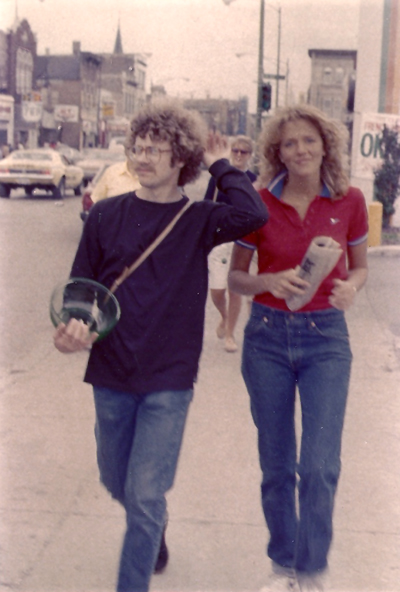
Yes, that's me, in my hirsute days,
wandering around Maxwell Street in
1982. The attractive young lady to my
left is my kid sister, in town for a visit.
One morning (the market ran from about 5 a.m. to around 1 p.m.), I came across a woman selling what appeared to be a pile of old newspapers. She had them arranged on an old tablecloth spread out on the sidewalk. Something caught my eye – an old photo of what looked like a saxophone player. I casually leafed through the stack and realized the bits of newsprint were a collection of clippings about an orchestra leader and his band. And the photos were studio shots that showed the dashing maestro with his men. The clippings were old, clearly from the '30s or possibly the '40s. I realized that here on the ground before me was the find of my collecting career!

I tried to maintain my cool while disinterestedly asking the woman how much she wanted for the pile. "Not for sale," was her abrupt reply. I was used to eccentric sellers at Maxwell Street, but this surprised me. "I just mean the newspaper scraps and these photos here," I said hopefully, pointing to the pile. She didn't even look at me. "Not for sale."   

I knew I needed to do something drastic. I found my friend and we pooled all the cash we had. Back at the woman's display, I held out a handful of bills. "Will you take $40 for the photos and the clippings?" The amount was wildly extravagant, an astronomical sum for a penurious grad student to pay for anything on Maxwell Street. But I knew those pictures and clippings were historical artifacts, perhaps the only extant evidence of some long-forgotten Chicago jazz band leader and his players. They had to be preserved at any cost.

The seller looked at me for the first time, and then looked hard at the money in my hand. Without saying a word, she snatched the cash and thrust it into the neckline of her sweatshirt. As she turned away, I quickly gathered up all the bits of paper and the photos and headed off down the street. "Now I got nothing left," I heard her saying after me. "That other fella took all the negatives. I ain't got nothing now." 

Later, I felt more than a twinge of guilt – a privileged white college kid taking advantage of an indigent black woman forced by circumstances to sell off her family's effects. That's how I imagined it, anyway, and a week later I returned to the market with professionally-made copies of the photos. After some looking, I found the woman and, with some satisfaction, presented her with the copies. "What's this?" she said, looking at the images with disdain. "I can't use this stuff – I want the negatives!" She tossed the images on her pile of wares and paid no more attention to me. I quietly left, figuring the encounter absolved me of any further concern over class exploitation.

The illustrious career of Count Rich and his Orchestra, as traced over a decade through yellowing posters, clippings, telegrams, night club programs and studio photographs.

When I got the collection of photos and paper bits home, I quickly realized that they once had been part of a scrapbook of memorabilia. Many of the pictures still had those little triangular photo corners attached them, and the backs of some of the paper clippings had traces of glue and the black backing paper of the page they'd once been affixed to. I only wish they'd been left intact in the book!

The Count, circa 1937
But here was the legacy of a musician and band leader who called himself Count Rich. He'd led a society orchestra in the early thirties, playing for debutante balls and afternoon socials on Chicago's South Side. In 1933, he began writing a regular column for a music weekly called Club Chatter News, advising aspiring band leaders on the etiquette of music making and offering music business tips. He signed himself "R. Near Rich," almost certainly an optimistic pseudonym. The publication served the near South Side and the African American community, then confined to a section of Chicago known as Bronzeville.

In the mid-'30s, Rich, ever the astute businessman, incorporated the increasingly popular swing jazz style into his band's sound. He hired "hot" soloists and, in 1934, scored a major gig performing for one of the first dance marathons held in Chicago. Produced by Leo Seltzer, who is best remembered today for inventing roller derby, the Depression era event featured dancers dragging themselves around the dance floor in an effort to outlast other couples and win a nominal cash prize. A marathon could last many weeks, and this one dragged on for fourteen. But Rich and his men grabbed headlines as the spectacle's hot jazz band – and an all-black outfit playing for an all-white event. They began broadcasting nightly at 11 over WCFL, and then over WBBM and WIND.

Harry's NY Cabaret, top,
and the Embassy Club.
There followed an lengthy series of gigs around Chicago at now-forgotten venues like the Zig-Zag, the Rheingold, Club Ruspantini, the Derby Cafe, Harry's NY Cabaret, the Airplane Inn and the Embassy Club. The band also performed at the famed Dreamland Cafe, the Arcadia Ballroom and Chicago's Savoy. Rich's little group was compared favorably to Jimmy Noone's, and there was some talk of touring. But for some reason the Count decided to stay in Chicago, thus denying the band an opportunity to become better known and perhaps make a few records. Though billed on one flyer as the "recording orchestra," Rich's group apparently never went into the studio.

Not only was Rich a leader, soloist and music columnist – he was also a composer. He wrote and arranged quite a number of tunes for the band, including "Hi-De-Harlem," "Black Moon," "London Fog," "Zig-Zag" (no doubt for the club of the same name) and "I've Never Found My Love." Featured soloists over the years included percussionist Eugene "Scotty" Scott, saxophonist Jesse Washington (supposedly from Bennie Moten's band), pianist Jimmy Howell and vibist Rudy Martin.

Ramey
One player who went on to national stature was guitarist Hurley Ramey. Starting out with Rich, he soon went with Horace Henderson's band and then on to Earl Hine's great orchestra. He was there when Charlie Parker, Dizzy Gillespie, Billy Eckstine and Sarah Vaughn were part of the group, and was recorded accompanying Bird on tenor in Bob Redcross's Chicago hotel room in 1940.

So here, for posterity, is a sampling of some of the Count Rich material, stored lovingly in my attic lo' these 35 years. On the off chance you might have any additional information about R. Near Rich, please don't hesitate to send it my way!

FROM THE COUNT RICH SCRAPBOOK

Count Rich and the boys on stage at the White City Ballroom, 63rd and South Ave. in Chicago. The year is probably 1934 and the players are, from left, Raymond Nelson, Hurley Ramey, Count Rich, Eugene Scott and two unknown violinists. In those days, all Chicago musicians had to play a string instrument regardless of what their main ax might be. Note the WIND microphone.
This picture may well have been taken in WCFL's broadcasting studios, judging by the baby grand. That would be an unlikely instrument to find in a club setting. The microphone is a giveaway, too. By November 1934, the Count Rich Orchestra was broadcasting regularly on WCFL's "band music program," and the photo may have been taken prior to one such show. Aside from Rich who is seated at the piano, we have Scott, saxophonist Faber Smith, Ramey and Nelson, from right to left. The other musicians are not known.
A selection of Rich's clips, including one of his columns, left. Clearly the Count was a Roy Eldridge fan – watch out "Old King Satchmo!" The Coliseum article ranks Rich's aggregation with the "Duke Ellington, Noble Sissle and Mills Blue Rhythm outfits" – odd company indeed! These articles come from the Chicago Defender and Club Chatter News.
More clips. The marathon article, left, is at pains to point out how well-behaved Rich's "youngsters" are, clear evidence of racial pride in a "whites-only" situation.
A portion of a poster for an unknown venue, touting Rich's radio connections and his recent appearance at the famed Savoy Ballroom. Probably from 1935. 
A telegram inviting the Count and the band to a breakfast dance at the Derby Cafe at 22nd and Wabash, presumably to perform. The 6 a.m. start time says a lot about how music back in those days was a 24-7 proposition. The Masonic Temple gig, below, touts Rich's star percussionist.
This is the last bit of memorabilia from the Count Rich collection. By 1939, the band was apparently playing fairly elaborate reviews in out-of-the-way places like Aurora, and though they were billing themselves as "Chicago's Swing Aristocrats," it must have been a hardscrabble existence. Next to the Rich material spread out on the Maxwell Street vendor's tablecloth were a series of period photos of a fleet of shiny new milk trucks. I can only think that Rich must have left the music business in the 1940s and started up a far more lucrative dairy delivery company.

OK, OK – I know this is supposed to be a recorded music blog with downloadable rarities for all. I apologize for being so verbose and for slagging you with so many images. To make amends, here are a couple of musical selections that feature Count Rich's guitarist, Hurley Ramey. The first is the famous "Jelly, Jelly, Jelly," by the Earl Hines Orchstra. It was a big hit for singer Billy Eckstine and was recorded for Victor in December 1940. You can hear Ramey playing electric Hawaiian-style guitar behind Eckstine's vocal. The other soloists include Scoops Carry, Budd Johnson (on clarinet) and the Fatha himself.

 
The other tune is of profound historical interest. It comes from the legendary Redcross recordings, made in a Chicago hotel room by Earl Hines' valet, Bob Redcross. Here we have Charlie Parker playing tenor – the instrument he played in Hines' band – with Ramsey accompanying. Hurley starts the piece off, sounding much the way he must have in Rich's group, and then Bird sets a tempo and plays several choruses of "Body and Soul." The date is February 1943, and this is one of the few very rare recorded instances of Parker during this period. 
Saturday, June 9, 2012

Free Beer Tomorrow

Here's a hot night at the National Press Club in Washington D.C., back in 1940. Art Hodes, left, is joined by, from left, Red Allen, Pete Johnson, Lou McGarity and Lester Young in a trad jazz jam session. Photo by William Gottlieb

There are a few musicians in the jazz idiom who have labored for decades playing music of depth, integrity and panache without ever achieving fame or fortune, or even much notice. One of those benighted few was pianist Art Hodes.

I originally heard him on a series of reissues that Blue Note (by then owned by Liberty Records) put out in the early '70s. The label had originally recorded Hodes in a series of small group settings – Art Hodes' Back Room Boys, Art Hodes and His Blue Note Jazzmen, Art Hodes' Hot Seven, Art Hodes ' Chicagoans – and the reissues showed him to be an uncomplicated though swinging player, a guy who clearly had a profound understanding of the blues. This was when I was in New York. Shortly afterward, I moved to Chicago, Art's hometown.

Art with Rod Cless, clarinet, and George Brunies,
trombone, at another session in a restaurant
circa 1940. 
Photo from A Pictorial History of Jazz
In Chicago, I developed a real appreciation of the blues – both the urban electric kind, and the kind played by Little Brother Montgomery, John Davis, Erwin Helfer ... and Art Hodes. I can't recall if I saw Art in person back then, but I believe I may have caught him as part of a larger ensemble in one of the early Chicago Jazz Festivals. He was still alive then and actively performing. 

While there, though, I did come across a couple of Hodes' LPs from the 1950s – in a recycling station on the city's South Side. There, amidst all the dumpsters of sorted colored glass, tin and aluminum cans, newspapers and magazines, were half a dozen boxes of long-playing records. Perhaps they'd been abandoned by some evicted jazz fan who'd fallen on hard times? I don't know, but there were some real treasures in those boxes, and the Hodes LPs were two of the best. The one included in this post is the better – and rarer – of the two.

"Mostly Blues" captures Art Hodes and a small group playing familiar tunes and a number of blues, just as the title suggests. The band, Chicagoans all, features a then-young guitarist named Marty Grosz (listed on the label as "Milt"), one of the very few rhythm guitarists who solos using chords. I saw him play live with tenorist Eddie Johnson and drummer Barrett Deems, and he was quite amazing. As he did then, he plays acoustically here and is very impressive. Also in the band is Freddie Kohlman, a fine traditional drummer originally from New Orleans but living in Chicago at the time of this date. He'd worked with Albert Ammons and Earl Hines prior to hooking up with Art.

The revelation, for me anyway, is bassist Truck Parham. Truck (born Charles Valdez Parham) was working as the doorman at the apartment building of a friend of mine when I was living in Chicago. I never met him, but I knew that he'd been an integral part of Windy City jazz history from the git-go, working with everybody from Roy Eldridge to Earl Hines to Art Tatum. He'd even studied with Walter Page. What strikes me about his playing here is how modern it sounds. Here's a gent who started playing bass right around the time bass players were switching from tubas to strings, and yet he sounds at moments like Oscar Pettiford or Ray Brown. He even bows his way through several choruses on a few of the tunes.

One last thing. Art Hodes not only played wonderful piano, he also wrote as good as he played. His prose style was like his keyboard approach – simple, straight-forward, honest and insightful. He wrote a column called "Sittin' In" for Down Beat magazine for about a decade, and here's the one from the August 26, 1965 edition. It's Art's take on racism in music, a topic that still resonates today.

As always, these files were ripped from the original vinyl with only a gentle cleaning of pops and clicks. Be forewarned, there is some slight surface noise.


Mostly Blues
Art Hodes and His Group
Art Hodes, p; Marty Grosz, g; Eddie Burleton, cl; Truck Parham, b; Freddie Kohlman, d. 
Chicago, IL; December 8, 1957; Audiophile AP-54

1. Dardanella
2. B-Flat Blues
3. Chimes Blues
4. Angry
5. After You've Gone
6. Apex Blues
7. Ain't She Sweet
8. Liberty Inn Drag
9. I Found a New Baby

Find it here: http://www.mediafire.com/?48tbncc1q5rr8xe

Monday, June 4, 2012

Jazz Romance, Pt. 2

Here's a brief addendum to the Joe Marsala/Adele Girard post of a few weeks ago. A local church sale yielded up this gem, complete with a lovingly hand-lettered sleeve. No doubt the previous owner was one of us – a collector of fine recorded sound, I mean. 

It's a Joe Marsala date for Decca from March 21, 1941, done in New York City shortly before the country's entry into World War II. Most of the players would soon be gone in the draft, and within a year nearly all studio activity would cease under the Petrillo recording ban. But in early 1941, things were humming along, and Marsala did a number of solid sessions for Decca. 

The title of this piece is "Bull's Eye," and I post it here because it's an Adele Girard original. It seems to draw from the classical repertoire, and even quotes a very familiar theme (so familiar, I can't think of where it comes from at the moment). Adele solos nicely, as do Joe and his brother Marty, as well as mysterious tenor man John Smith (unknown to me, and with a name like his, completely unsearchable on the interwebs). Also of interest is 20-year-old drummer Shelly Manne, who gets in some very nice fills (and starts off the piece). For the record, here's the personnel: Marsala, clarinet; Marty Marsala, trumpet; Ben Glassman, alto, clarinet; Smith, tenor; Dave Bowman, piano; Girard, harp; Carmen Mastren, guitar; Jack Kelleher, bass; and Manne, drums. It's scratchy, but heck, what'd you expect from a 70-year-old bit of phonography?
 

Monday, May 28, 2012

Harry's Bari

Harry Carney in the early '70s was just as dapper a gent as he was back in the 1920s. His sound remained the backbone of Ellington's arrangements right up to his death in 1974. Photo from the Illustrated Encyclopedia of Jazz

When you think of romantic music, you think of ... baritone saxophone? Well, maybe not. But you might, if you think of Harry Carney, Duke Ellington's long-time bari sax player.

Carney came from Boston, as did Johnny Hodges, where he and the Rabbit were childhood friends. Harry had just turned seventeen when Ellington heard him playing with a local band and, after obtaining permission from Carney's parents, took him on the road with his orchestra. Carney played clarinet with the Duke at first, but soon was featured on the big saxophone. He never looked back, and he never left Ellington's sax section. He is, by most estimations, the father of modern baritone saxophony.

Carney only recorded a few times as a leader, and only issued two LPs in his lifetime. The one Gems is posting here comes from the mind of impresario and producer Norman Granz, another of the concept recordings that were so successful for him and his musicians. It features Carney in a ballad setting with a number of excellent jazz players and a conventional but supportive string section. No credit is given for the arrangements, but they were probably done by one of Granz's many studio arrangers – maybe Howard Lucraft or Frank DeVol. The mood is intended to be romantic, no doubt a ploy to rope in the unwitting record buyer. 

But the results are far better than you might expect. This is a stunning record. There are many solos from Harry, plus some fiddling by Ray Nance and a generous dose of fine clarinet playing from Jimmy Hamilton. The material is familiar (with the exception of the two Carney originals), but the treatment breathes new life into it. You'll be sorry if you pass this one up, brother!

I found this LP many years ago at one of the first record sales held by the radio station where I work. Why someone would dump this gem is beyond me, but I'm certainly glad they did, and now you will be too. As always, these files were ripped from the original vinyl with only a very minor cleaning of random pops and clicks.


Moods for a Girl and Boy
Harry Carney and His Orchestra
Harry Carney, bar, bs cl; Ray Nance, tp, vi; Tony Miranda, fr hn; Leroy Lovett, p; Billy Bauer, g; Wendell Marshall, b; Louie Bellson, d; unk. string section
New York, NY; December 14, 1954; Verve MG2028

1. I Don't Stand a Ghost of a Chance
2. Take the A Train
3. We're in Love Again (Carney)
4. Chalmeu (Carney)
5. Moonlight on the Ganges
6. It Had to Be You
7. Fantasy
9. I Got It Bad

Find it here: http://www.mediafire.com/?7qchshh7dthvbp5

Friday, May 11, 2012

Song of the Unsung

This natty fellow was both a student of Captain Walter Dyett at DuSable High School and an early member of the AACM. He has gigged around Chicago for decades without ever really receiving his due. A mystery. Photo courtesy of Jimmy Ellis

Multi-reed instrumentalist Jimmy Ellis is well known in Chicago for his sinewy post-bop alto playing, but he is largely unheard of everywhere else. Why is that? I don't know, but it could have something to do with the fact that he has never recorded (that I aware of). Why that is, I also don't know. I suppose the same thing could be said of Jodie Christian, though he's made numerous records as a sideman. Not Jimmy, though.

Jimmy Ellis today
I first met Jimmy when I worked with a jazz club producing concerts at Northwestern University in 1979. He'd been recommended as an excellent player and a very together leader, and he proved to be that and more. We arranged to present his quartet and another band in a concert at the university and, in order to promote the show, did an interview with him at his Hyde Park apartment that we later broadcast over the student radio station. Jimmy gave me a tape of his group playing at a local club so that we could mix in some music with the conversation. 

The concert was a big success, and Jimmy Ellis was quite as pleased as we were. He knew that we were into the AACM, so to celebrate he presented us with what he laughingly called an avant garde piece – a tape of himself improvising on soprano to the rhythms that his clothes dryer produced. I still have it somewhere – a hoot!

We didn't record the concert (that I can recall), but I did hold on to the quartet tape Jimmy gave me. I think you'll be interested to hear the unsung reed man from Chicago. His style is sparser than that of most Eastern boppers, more bluesy and vocal but with a kick to it. The tape only contains two tunes, so instead of posting them as a download I'll simply put in the players below. One piece is Dizzy's "Night in Tunisia" and the other I believe is "The Night Has a 1,000 Eyes." The performance could be from a date at the Bee Hive, probably from around 1974 or '75. Jimmy's on alto, and Al Jenkins is the pianist with Shante Hamilton on bass and Bill Yancy playing drums. 

By the way, shortly after the Northwestern concert Jimmy Ellis and his quartet played at my wedding – a very swinging affair!


Monday, May 7, 2012

Praise Mary Lou

Sister Williams at the keyboard in later years. Mary Lou's story is a remarkable one, taking her from the speakeasies of Prohibition-era Kansas City to Carnegie Hall, and in the end she was sustained an abiding and deep Catholic faith. Photo from The Illustrated Encyclopedia of Jazz

I first learned about Mary Lou Williams when I came across a 78-rpm album of hers on the Asch label at a library sale in Ithaca, NY. I was all of 19 and new to jazz, and she was the first female instrumentalist I'd encountered. The records were trio sides done in 1944 with bassist Al Hall and trumpeter Bill Coleman, and they made me a life-long fan. I learned much later that the Asch date sported one of the first jazz covers done by famed illustrator David Stone Martin. He and Mary Lou had met when she was playing at Cafe Society a year earlier and had become lovers. But that's another story.

Mary Lou Williams with friends and proteges – can you
name them all? A still from "A Great Day in Harlem."


Mary Lou Williams' career was an exceptional one. Married in her teens to reed man John Williams, she played first in his band in Memphis and then gained a seat in Andy Kirk's KC aggregation when the band's regular pianist failed to show and Ms. Williams was enlisted to fill in. She spent the next decade with Kirk, doing the band's arrangements, composing many of its most popular tunes, and performing as its featured soloist. In the '40s, she moved to New York City and established a salon of sorts for young, up-and-coming players like Bud Powell, Dizzy Gillespie, Charlie Parker and many others. In the late '50s she left music after converting to Catholicism and worked to help musicians overcome drug dependencies. She eventually returned to performing in the late '50s at the behest of Dizzy Gillespie and had a productive career as a modernist for another two decades.

I had a friend when I was living in Chicago who worked for a while for Catholic Television – yes, there is such a thing – and he came to me one day with an interesting offer. He knew I was into jazz, and he said they'd recently done a show with an older woman who was supposed to be a famous jazz musician. Her name was Mary-something, and would I like an audio dub of the show? Sure, said I, wondering who Mary X might be. Well ...

As it turned out, Mary was Mary Lou Williams. At this point in her career – this was 1980 – she was routinely doing a truncated "history of jazz" as part of her performances. She would start with spirituals, move to ragtime, then blues and swing, and finally conclude with bebop. Each era was represented by Mary Lou's marvelously intricate playing. Each tune was not a particularly faithful or even close recreation of the style it was meant to illustrate but more a portrait of Ms. William's own journey through the evolution of jazz. Mary Lou was game for just about anything in those years, and she even recorded her history of jazz in duet with Cecil Taylor in 1977.

Apparently Mary Lou Williams had done a version of her history for Catholic TV. The video is probably on a dusty shelf in a storage room somewhere in Chicago, but the audio is offered here in this post. As it's only about 20 minutes in length, I've added another rare recording of Ms. Williams from a Carnegie Hall date with Honi Gordon, Leon Thomas and the Interfaith Chorus. It was issued on the Avant Garde label (an imprint of the Vanguard company) and probably sold all of a dozen copies. Despite the verbose announcer, the music is first rate with lots of piano from Mary Lou. Honi Gordon – Mingus's favorite vocalist – gets in a glorious rendition of the Lord's Prayer as arranged by Mary Lou, and Leon Thomas avoids the yodeling gimmick that made/marred many of his later performances. This performance, in a small way, ranks right up there with the sacred music concerts of Duke Ellington.

As always, the files here were taken from the original analog audio sources with just a very minor cleaning of the sound. The Catholic TV dub retains the test tones and studio chit-chat that appeared on the original. I've included only side one of the Avant Garde LP as the second side features a folk trio – not of interest here.


A History of Jazz
Mary Lou Williams, p.
Catholic Television broadcast, Chicago 1980

1. Spiritual
2. Ragtime
3. The Blues
4. Kansas City
5. Boogie Woogie
6. Bebop (A Night in Tunisia)
7. Offertory (from Mary Lou's Mass)

Praise the Lord
Mary Lou Williams, p; Julius Watkins, frh hn; Bill Salters, b; Percy Brice, d; Leon Thomas, Honi Gordon, v; Interfaith Chorus, v; Bobby Banks, cond; unknown emcee.
Carnegie Hall, New York, NY; February 5, 1967

8. Introduction
9. History of Jazz
10. Joycie
11. Thank You, Jesus
12. Our Father
13. Praise the Lord

Find it here: http://www.mediafire.com/?13by2syy4r9n020